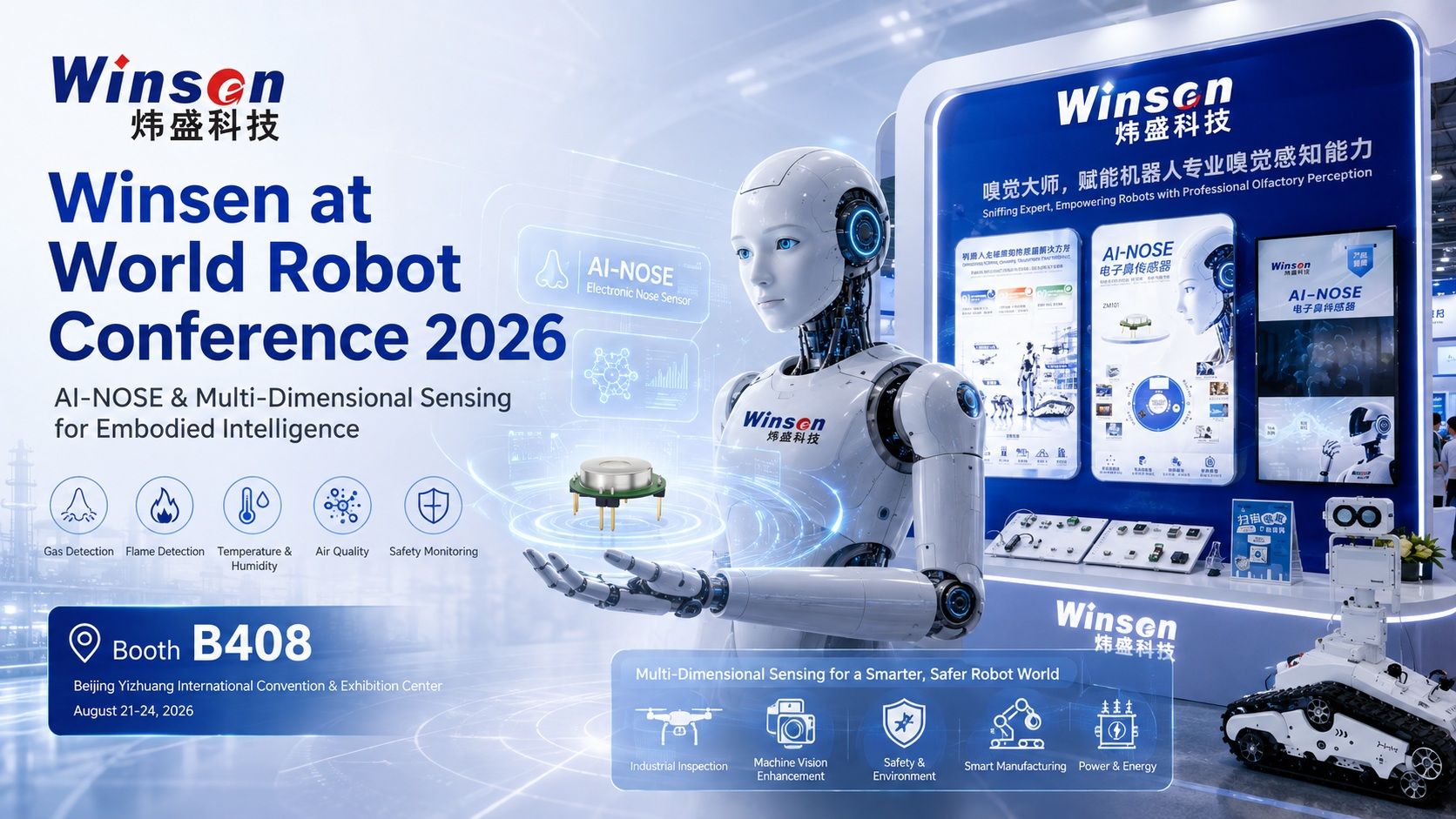
ది World Robot Conference 2026 officially opened in Beijing on August 19, bringing together more than 300 robotics-related companies, over 2,000 exhibits and more than 150 debut products.
From humanoid robots and industrial automation to autonomous inspection platforms and embodied intelligence, this year’s event highlights an important shift in the robotics industry: robots are moving beyond laboratories and demonstrations and entering increasingly complex real-world environments.
At Booth B408, Winsen is showcasing a capability that is becoming increasingly important for this transition:
environmental sensing and olfactory perception for robots.
Vision allows robots to see. AI models allow robots to analyze and make decisions. But when robots enter factories, energy facilities, underground spaces, homes or public environments, many important risks and environmental changes cannot be identified visually.
Gas concentration, odors, oxygen levels, VOCs, air quality, temperature, humidity, particles and other environmental parameters all provide information that cameras alone cannot capture.
This is where gas sensing, environmental monitoring and AI-powered olfactory sensing can add a new dimension to embodied intelligence.
Beyond Vision: Why Robots Need More Environmental Sensing
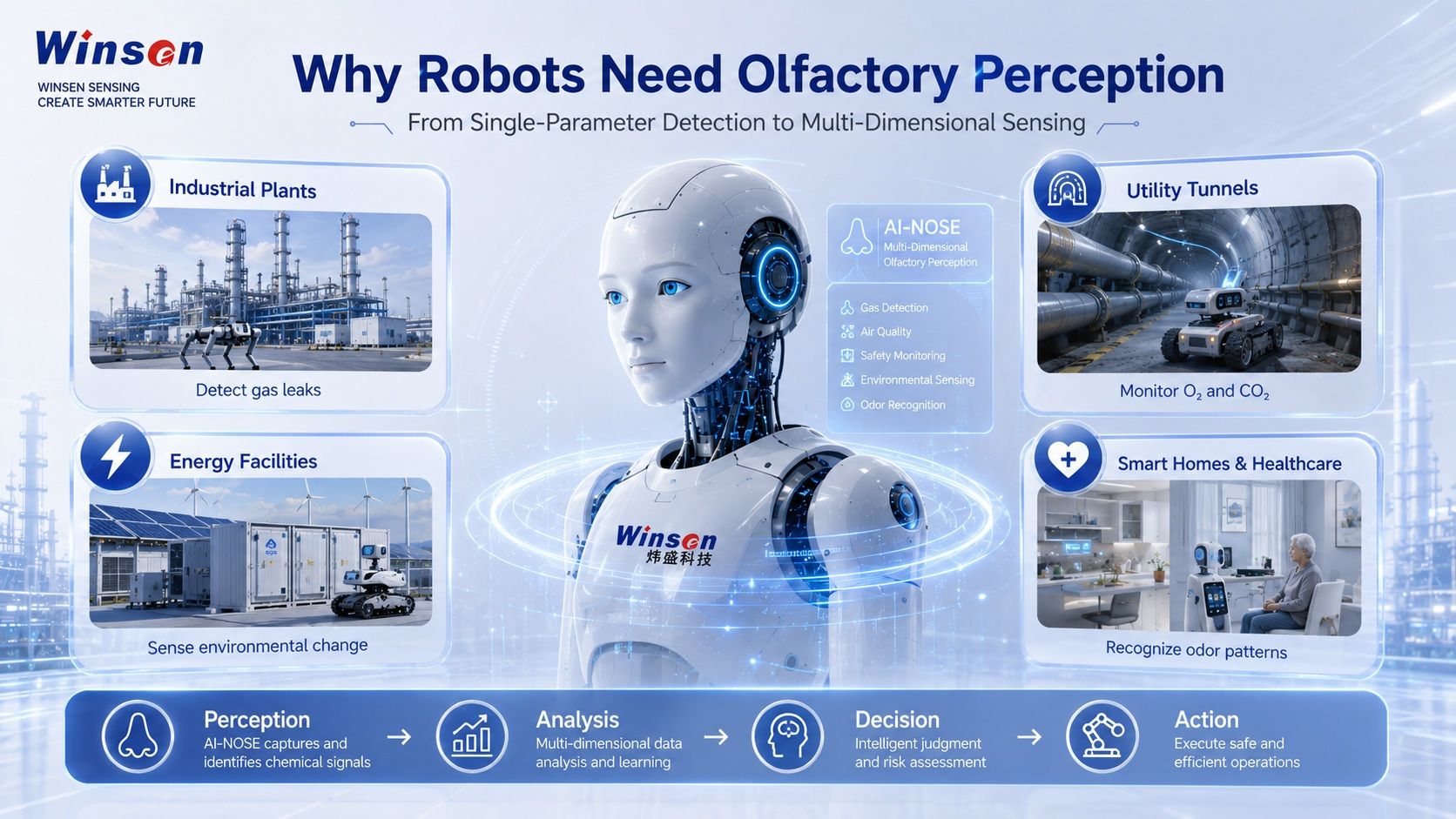
Robots are increasingly being deployed in environments that are dynamic, unpredictable and sometimes hazardous.
An industrial inspection robot entering a chemical plant may need to detect combustible or toxic gases before approaching equipment.
A robot operating in an underground utility tunnel may need to identify oxygen deficiency, abnormal CO₂ levels or hazardous gas accumulation.
An autonomous platform in an energy facility may need to continuously monitor temperature, humidity, particulate matter and gas conditions.
Service robots operating in homes, healthcare environments and commercial spaces may eventually need to distinguish air-quality changes, abnormal odors or characteristic smell patterns.
These applications require robots to perceive information beyond shape, distance, color and sound.
For embodied intelligence, environmental sensing may include:
- combustible gas detection;
- toxic and hazardous gas monitoring;
- oxygen concentration monitoring;
- CO₂ detection;
- VOC and odor sensing;
- temperature and humidity;
- particulate matter and air quality;
- pressure sensing;
- flame and fire-related sensing.
By combining these parameters with vision, positioning, AI models and motion control, robots can build a more complete understanding of their surroundings.
From Single-Sensor Detection to Multi-Dimensional Perception
Traditional sensing systems are often designed around a single question:
Is a particular gas present?
As robotic applications become more complex, the questions are changing.
Robots may need to determine:
- Is the surrounding environment changing?
- Does the change indicate a possible safety risk?
- Are several environmental parameters changing simultaneously?
- Does a gas or odor pattern match a previously learned condition?
- Should the robot continue operating, investigate further or trigger an alarm?
This is driving sensing technology from single-parameter detection toward multi-sensor fusion and environmental understanding.
Winsen provides sensor technologies covering multiple dimensions of environmental perception, including combustible gases, toxic gases, CO₂, VOCs, odors, oxygen, temperature, humidity, particulate matter, pressure and flame detection.
Different sensors can be combined according to the robot’s application and operating environment.
For example, an industrial inspection robot may combine:
CH₄ + CO + H₂S + O₂ + temperature/humidity
while a service robot focused on indoor environmental quality may integrate:
CO₂ + VOC + odor sensing + particulate matter + temperature/humidity
The goal is not simply to install more sensors.
The goal is to provide robots with the environmental information needed to make better decisions.
ZM101-A AI-NOSE: Giving Machines a Sense of Smell
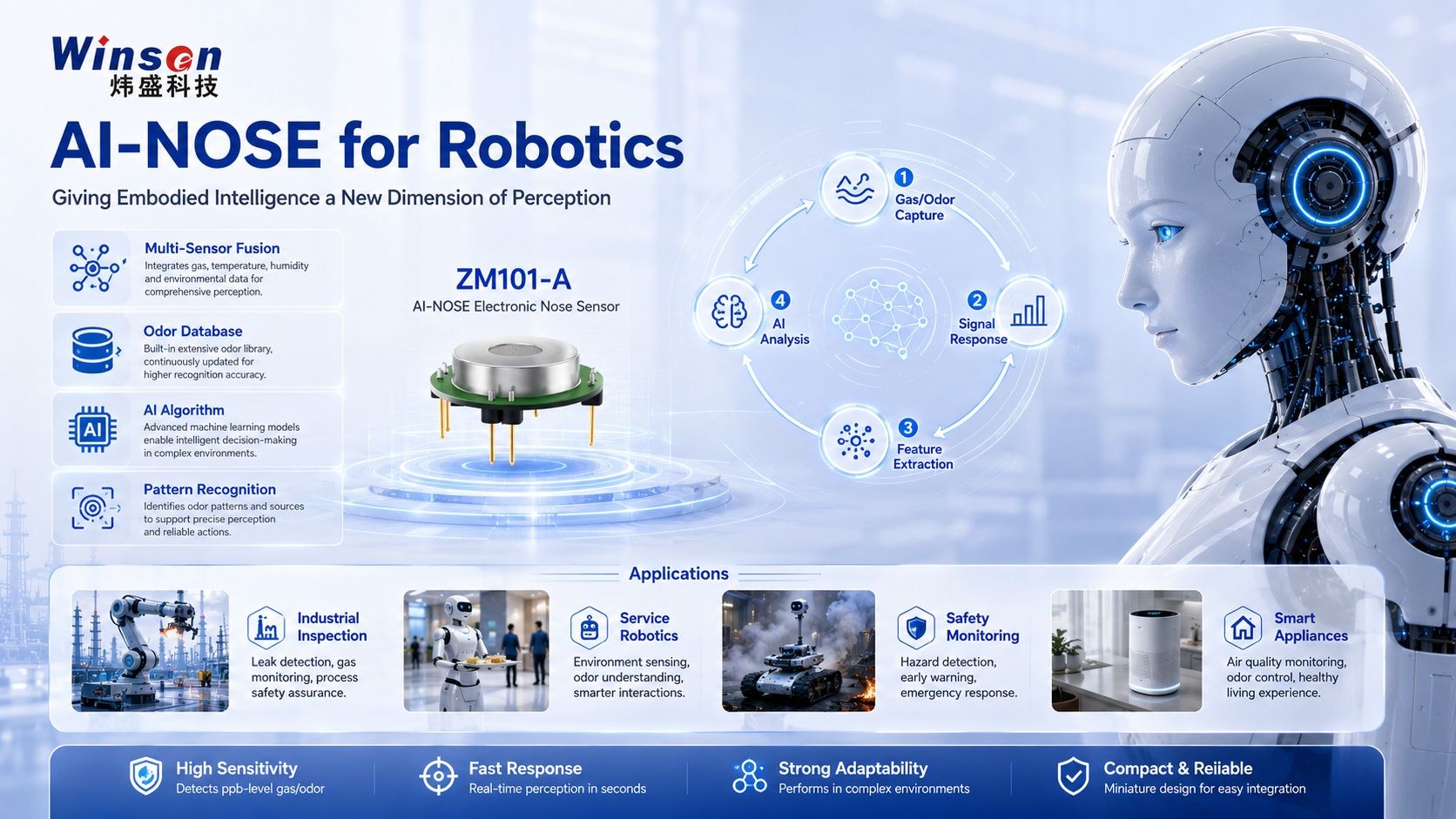
One of the products attracting particular attention at the Winsen booth is the ZM101-A AI-NOSE.
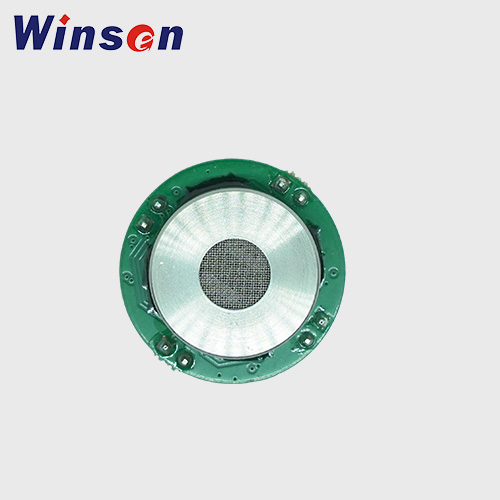
The ZM101-A is an intelligent electronic nose sensor platform based on a multi-channel MEMS gas sensor array.
Instead of relying on a single gas concentration value, the system analyzes the combined response characteristics of multiple sensing channels.
A typical AI-NOSE workflow can be represented as:
Odor / Gas Exposure → Multi-Channel Sensor Response → Feature Extraction → AI Model Analysis → Pattern Recognition
This creates a path from conventional gas detection toward complex odor recognition and chemical perception.
Multi-Channel MEMS Sensor Array
ZM101-A integrates six MEMS sensing units and can support different channel combinations according to the target application.
The available sensing dimensions include gases such as:
- NH₃;
- VOCs;
- NO₂;
- H₂S;
- CO;
- CH₄.
Multiple sensor responses form a characteristic pattern or “odor fingerprint” that can be analyzed by algorithms.
AI-Based Pattern Recognition
The real value of an electronic nose is not simply collecting six separate gas readings.
By combining sensor-array signals with feature extraction, training datasets and AI models, the system can be developed to recognize characteristic gas or odor patterns.
This enables applications to move from:
“How much of one gas is present?”
toward:
“What type of odor or chemical pattern am I sensing?”
Compact Integration for Intelligent Devices
The ZM101-A is designed for integration into intelligent terminals and sensing systems.
Its compact architecture makes it suitable for research and development involving:
- embodied intelligence;
- industrial robots;
- smart appliances;
- environmental monitoring;
- automotive sensing;
- odor recognition systems;
- AI-based gas analysis.
For detailed product information, visit the ZM101-A AI-NOSE product page.
What Can AI-NOSE Technology Enable for Robotics?
Olfactory sensing is still an emerging capability in robotics, but it opens a number of promising application directions.
Industrial Inspection Robots
Industrial inspection robots may encounter gas leaks and environmental abnormalities that are impossible to identify visually.
An electronic nose or multi-gas sensing system can potentially support:
- combustible gas inspection;
- toxic gas detection;
- VOC abnormality monitoring;
- process-gas identification;
- suspicious gas source investigation.
Combined with robot positioning, sensing data can also be mapped to a specific location.
This makes it possible for a robot not only to report that an abnormal gas condition exists, but also to indicate where it was detected.
Smart Mining and Underground Inspection
Mines, tunnels and underground utility spaces can contain rapidly changing atmospheric conditions.
Robots equipped with environmental sensors can monitor parameters such as:
- CH₄;
- CO;
- H₂S;
- O₂;
- CO₂;
- temperature;
- humidity.
This allows autonomous platforms to inspect potentially hazardous areas before personnel enter.
Energy and Power Facilities
Inspection robots are increasingly used in power stations, substations, energy-storage facilities and industrial infrastructure.
Environmental sensing can complement vision and thermal imaging with information related to:
- abnormal gas release;
- air-quality changes;
- decomposition gases;
- smoke or early fire signals;
- temperature and humidity.
Emergency and Fire Response
Fire and emergency environments often contain invisible hazards.
Robots integrating gas, smoke, flame and environmental sensors can help collect information remotely before emergency personnel enter a dangerous area.
This may include:
- combustible gas concentration;
- toxic combustion products;
- oxygen deficiency;
- temperature;
- smoke;
- flame information.
Service Robots and Smart Spaces
Olfactory sensing also has potential outside industrial safety.
Possible future applications include:
- indoor air-quality assessment;
- abnormal odor detection;
- food freshness recognition;
- household odor identification;
- smart appliance control;
- healthcare-related sensing research.
Each application requires its own sensor configuration, dataset and algorithm validation, but the underlying concept is the same:
give machines access to chemical information that cannot be obtained through vision alone.
Building the Perception–Decision–Action Loop
The ultimate value of sensing is not simply generating more data.
The data must become part of the robot’s decision-making process.
A future robotic sensing workflow may look like this:
- Environmental sensors continuously collect gas and physical parameters.
- Multiple signals are analyzed together.
- AI algorithms identify an abnormal environmental pattern.
- The robot associates the event with its current location.
- The control system evaluates the level of risk.
- The robot changes its route, performs additional inspection or sends an alarm.
- Data is transmitted to a remote management platform.
This creates a complete loop:
Perception → Analysis → Decision → Action
For embodied intelligence, this is particularly important.
A robot that can see an obstacle may avoid it.
A robot that can detect an invisible gas leak may understand that an apparently normal environment is actually unsafe.
That difference represents an important step from robotic automation toward true environmental awareness.
Environmental Sensing Solutions for Different Robot Platforms
There is no single sensing configuration suitable for every robot.
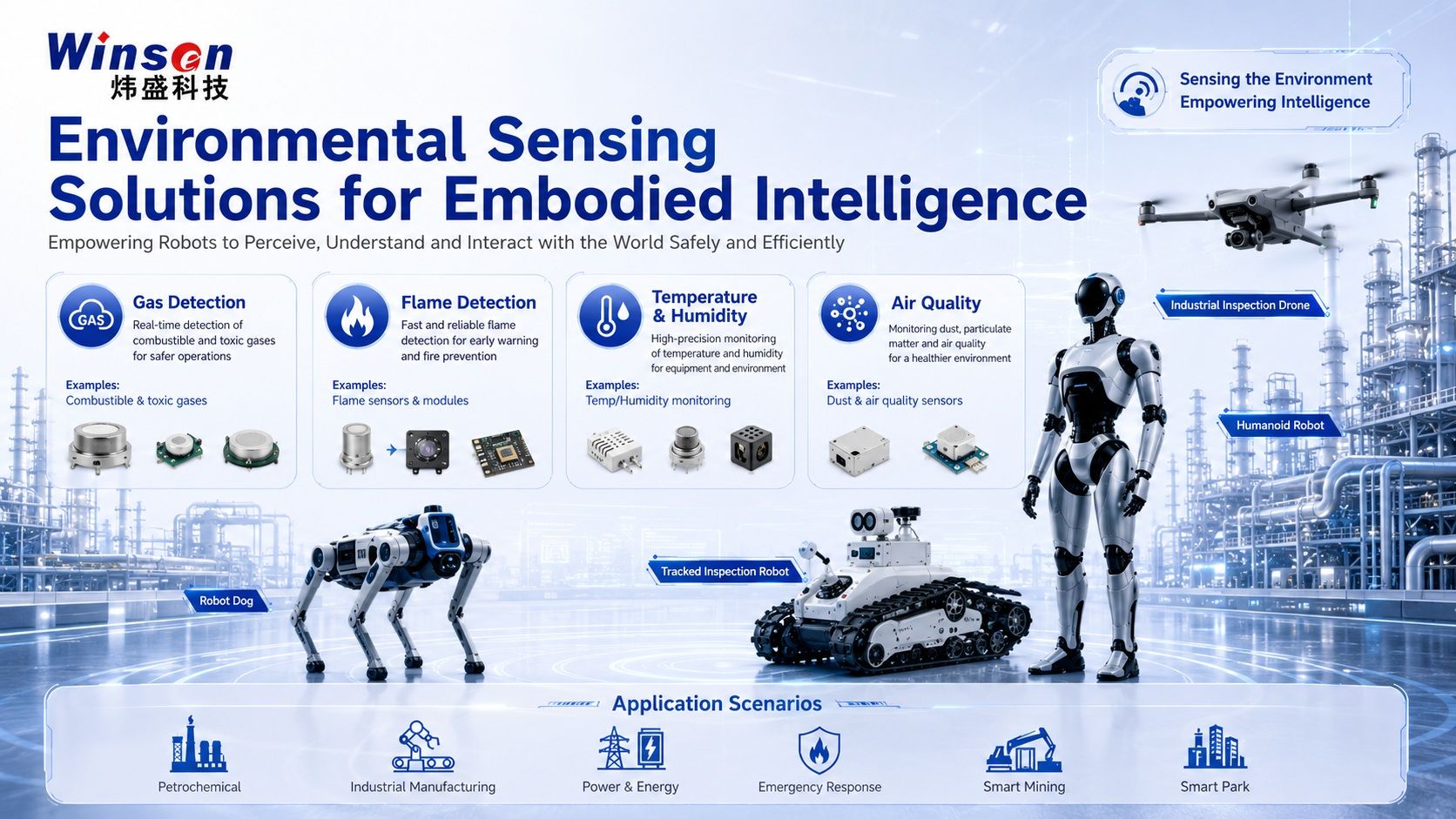
A humanoid robot, quadruped robot, UAV, tracked inspection platform and autonomous mobile robot may require completely different sensor combinations.
Winsen therefore focuses on application-oriented sensing solutions.
Gas Detection Solutions
Sensor technologies can support detection of:
- combustible gases;
- toxic gases;
- oxygen;
- CO₂;
- VOCs;
- industrial process gases.
These solutions can be applied to industrial inspection, emergency response and safety-monitoring robots.
Flame Detection Solutions
Flame sensing technologies and modules can support:
- fire inspection;
- industrial fire prevention;
- autonomous emergency response;
- high-risk equipment monitoring.
Environmental Monitoring Solutions
Robotic platforms can also integrate:
- temperature and humidity sensors;
- particulate matter sensors;
- air-quality sensors;
- pressure sensors.
These parameters provide additional environmental context for autonomous operation.
Multi-Sensor Fusion
Combining several sensing dimensions allows robots to obtain a more complete environmental picture.
Gas sensing can be combined with:
- cameras;
- LiDAR;
- thermal imaging;
- positioning;
- acoustic sensing;
- AI models.
This type of multi-modal architecture can become an important foundation for robots operating autonomously in complex environments.
Strong Interest in AI-NOSE at World Robot Conference 2026
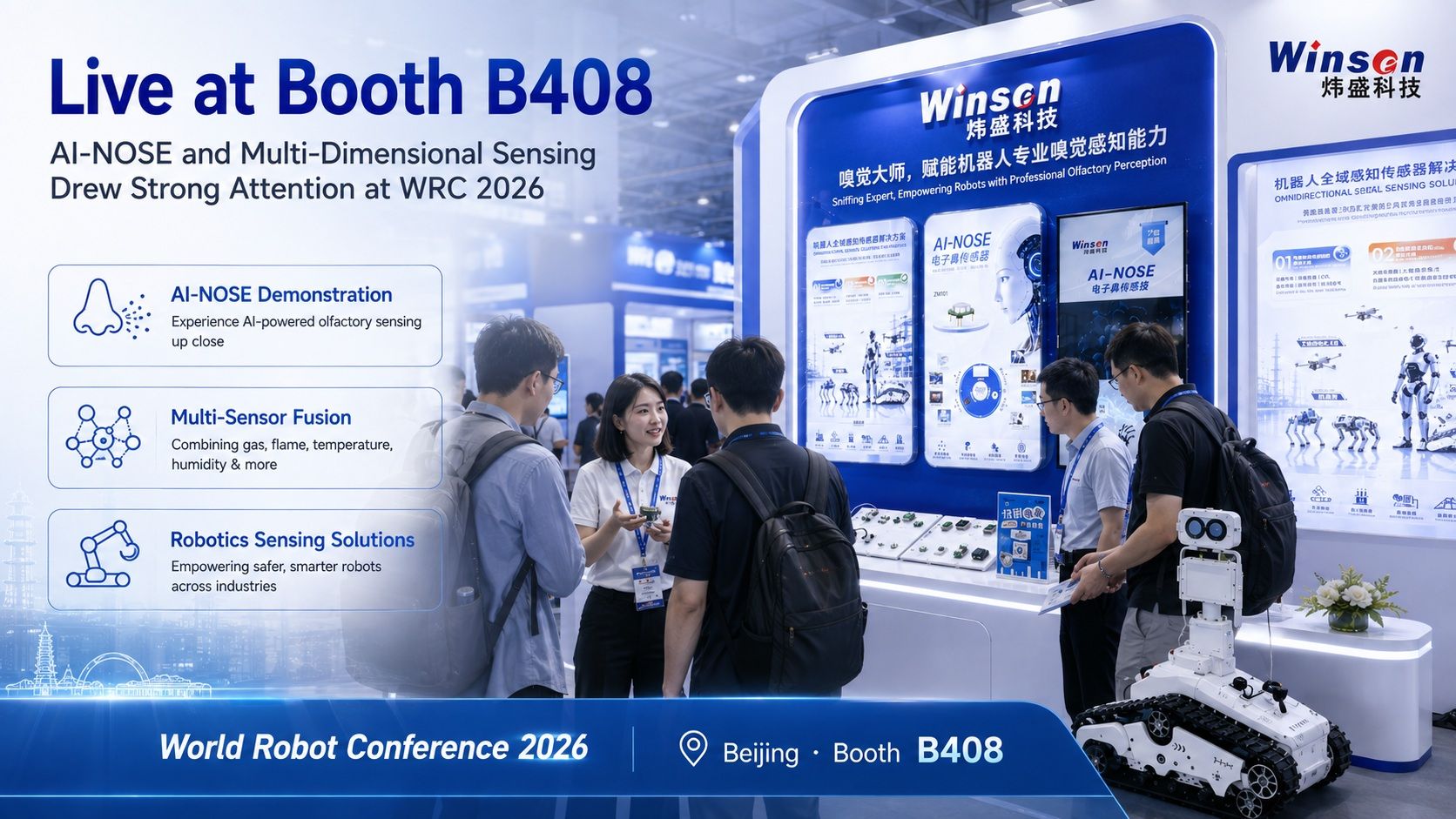
During World Robot Conference 2026, the AI-NOSE and environmental sensing solutions displayed at Winsen Booth B408 have attracted strong interest from robotics companies, engineers, researchers and industry visitors.
One recurring discussion is how gas and odor sensing can complement existing robot perception systems.
Today, many advanced robots already integrate:
- cameras;
- LiDAR;
- force sensors;
- inertial sensors;
- microphones;
- position sensors.
Chemical and environmental perception adds another dimension.
For industrial inspection, safety monitoring and service robotics, this additional information can help machines understand conditions that are otherwise invisible.
The increasing interest in AI-NOSE technology reflects a broader question facing the robotics industry:
If robots are expected to operate in the same physical world as humans, how much of that world should they be able to sense?
Winsen’s experience in gas sensing provides a technical foundation for exploring this next generation of robotic perception.
From Demonstration to Real-World Deployment
One of the clearest trends at World Robot Conference 2026 is the industry’s shift toward practical applications.
A robot operating in a laboratory faces predictable conditions.
A robot working in the real world does not.
Factories contain dust, VOCs and industrial gases.
Energy facilities may contain combustible or toxic gases.
Underground environments may become oxygen deficient.
Outdoor robots face changing temperature, humidity and weather conditions.
Emergency scenes contain smoke, heat and hazardous combustion products.
For robots to operate reliably in these environments, sensing systems must also be designed for real operating conditions.
This is why environmental sensing will become increasingly important as embodied intelligence moves from technology demonstrations toward large-scale industrial deployment.
Helping Robots Not Only See the World, but Sense It
The next generation of intelligent robots will need increasingly rich environmental perception.
Vision will remain essential.
But vision alone cannot tell a robot whether the surrounding air contains methane, hydrogen sulfide, VOCs or abnormal odors.
Gas sensors, environmental sensors and AI-powered electronic noses provide access to another layer of the physical world.
From single-gas detection to multi-sensor fusion, and from concentration measurement to odor-pattern recognition, Winsen is continuing to explore how sensing technology can support the development of embodied intelligence.
Our goal is simple:
Help robots not only see the world, but sense it more completely.
Meet Winsen at World Robot Conference 2026
World Robot Conference 2026 is being held in Beijing from August 19–23, 2026.
Visit the Winsen team at:
Booth B408
Featured technologies include:
- ZM101-A AI-NOSE;
- combustible gas sensing;
- toxic gas sensing;
- environmental monitoring;
- flame sensing;
- multi-sensor fusion;
- robotic environmental sensing solutions.
If you are developing an industrial inspection robot, humanoid robot, quadruped robot, autonomous platform or other embodied intelligence system, our engineering team welcomes the opportunity to discuss your environmental sensing requirements.
Explore the product: