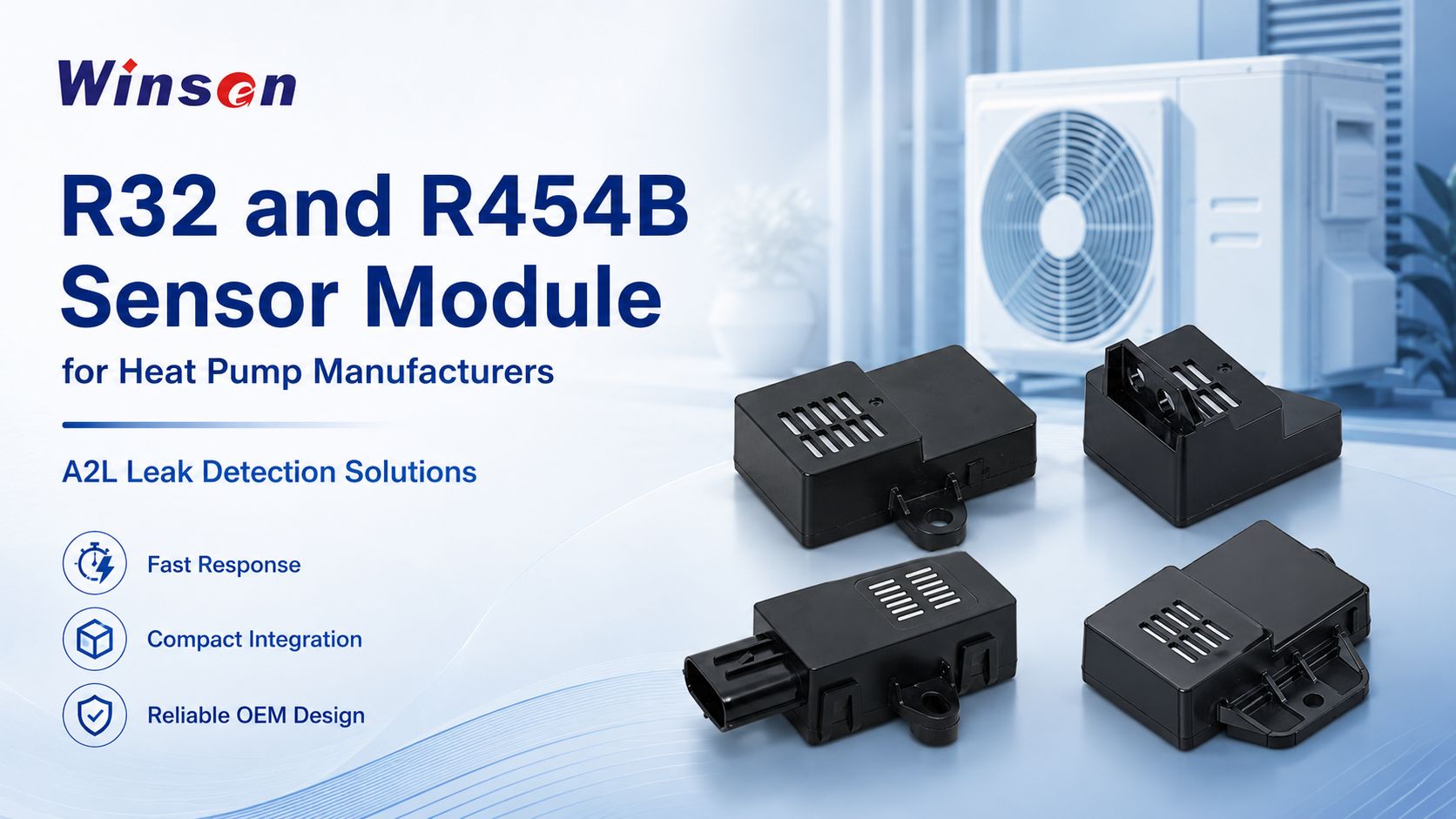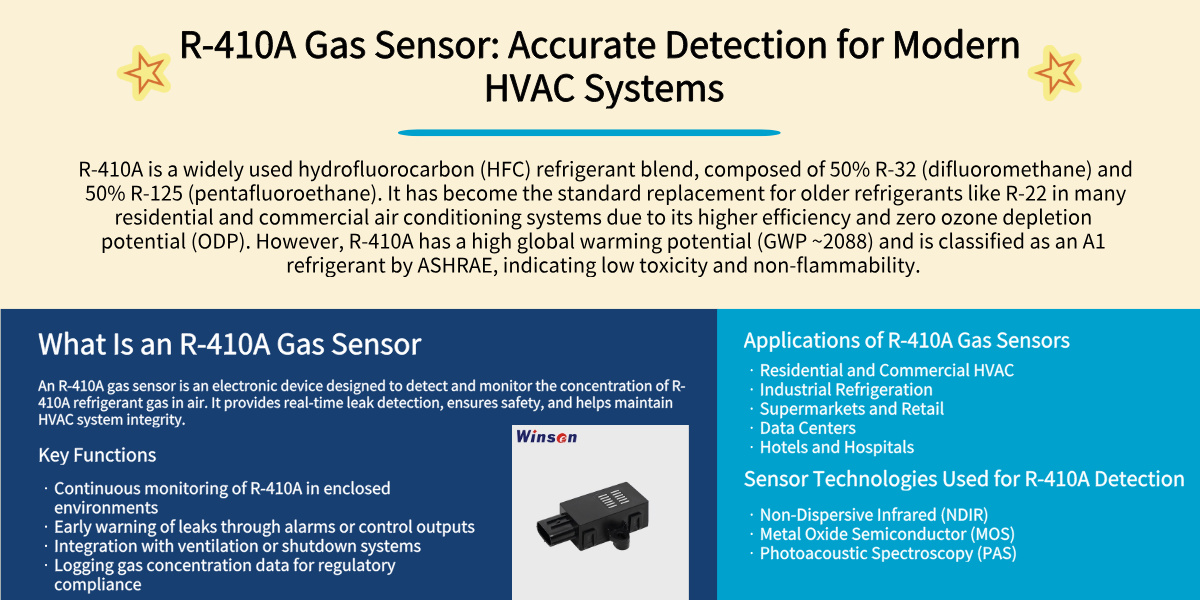
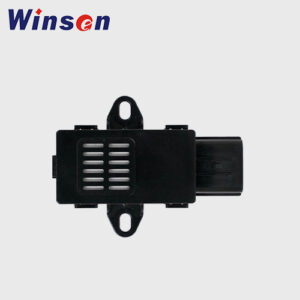
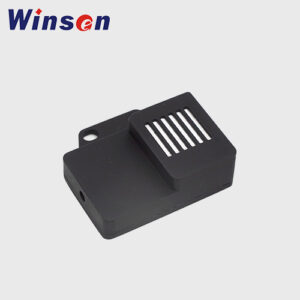
AC Freon Leak Sensor (Leak Detector) — Split/VRF • Central AC • Auto A/C
Winsen® manufactures electronic leak sensors for air-conditioning nagpapalamig across residential, commercial, and automotive applications. For building HVAC, we cover R410A, R32, R454B, and legacy R134a/R22*; for automotive A/C we support R1234yf at R134A. Choose Ay n para sa ppm maagang babala at MOS/DIR for %LEL safety interlocks with 4–20 mA, RS-485 Modbus, at mga output ng relay ready for BMS/PLC integration.


Model Guide — Pick by AC Type & Refrigerant
Home/Commercial AC — A1 (NDIR PPM)
- Ranges: 0–1,000 / 0–5,000 ppm (custom)
- Mga Output: 4–20 mA, RS-485 Modbus, 1–2 relay
- T90 ≤ 30 s • Mababang drift, mahabang buhay
*R22 is legacy/service gas in many regions.
Home/Commercial AC — A2L (NDIR PPM / %LEL)
- PPM early warning (NDIR) at/o 0–100% LFL/LEL
- 4–20 mA / RS-485 / mga relay
- Ideal for VRF/VRV rooms & hotel guestrooms
Automotive A/C — A2L/A1
- NDIR ppm for process/comfort; %LEL for interlocks
- Integrate at charge stations, test booths, bays
- Modbus for line interlocks & traceability
What “AC Freon” Means
In everyday language, “Freon” often means any AC refrigerant. Technically, Freon™ is a trademark historically used for CFC/HCFC/HFC products (e.g., R12/R22). This page uses “AC Freon leak sensor” in the common sense—mga electronic fixed sensor na nakakakita ng mga pagtagas ng nagpapalamig in air-conditioning systems.
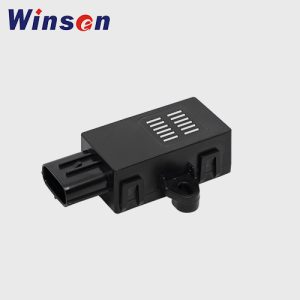
NDIR Refrigerant Sensor
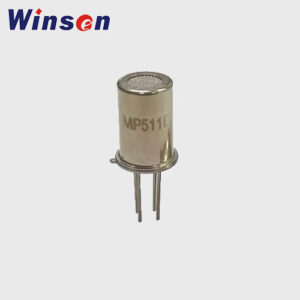
Semiconductor Refrigerant Sensor
How Infrared (NDIR) Refrigerant Sensors Work
| Stage | What Happens | Benepisyo |
|---|---|---|
| Emission | IR source emits broadband light through the gas sample. | Reliable optical excitation |
| Filtering | Narrowband optical filter targets refrigerant absorption bands; a second channel serves as reference. | Gas selectivity & drift compensation |
| Detection | Photodetectors measure attenuated signal vs. reference; MCU computes concentration. | Stable ppm / %LEL output |
| Compensation | Temperature/pressure & baseline routines (e.g., ABC optional) correct drift. | Long intervals between calibrations |
Typical AC Applications
Split/VRF indoor units & hotel rooms
Mount low (~150–300 mm above floor) near indoor units, under beds/sofas in hotel rooms, and other pooling points. Pre-alarm → fresh-air purge; main alarm → fan/indoor-unit shutdown.
Central AC air handlers & mechanical rooms
Place near coils, expansion valves, and floor low spots/sumps; use IP-rated enclosures. Integrate with BMS to start purge fans at pre-alarm and trip systems at main alarm.
Line sets, evaporator/condensing sections
Monitor around brazed joints, service valves, and manifolds; avoid strong supply streams that bypass the sensor.
Automotive service bays & EOL test
Position near charging/recovery stations and low-lying areas. Use ppm early warning plus %LFL safety interlocks (beacon/horn/vent).
Mga Pagpipilian sa Teknolohiya
| Teknolohiya | Pinakamahusay Para sa | Saklaw | Kalamangan | Mga pagsasaalang-alang |
|---|---|---|---|---|
| NDIR (Infrared) | A1 ppm; A2L ppm/%LEL | ppm → %LEL | High selectivity & stability; not O₂-dependent; long life | Protect from heavy condensation/dust (filters/enclosure) |
| MOS (Semiconductor) | A2L/A3%LEL | 0–100% LEL | Mabilis na tugon; matatag; cost-effective | Cross-sensitivities possible; periodic calibration advised |
| Catalytic Bead | Pangkalahatang hydrocarbon (A3) | 0–100% LEL | Mature tech for flammables | Requires O₂; susceptible to poisons (silicones/lead) |
Placement & Setpoints — Good Practice for AC
- Taas ng pag-mount: Most AC refrigerants are heavier than air ⇒ mount low; confirm with room airflow.
- Saklaw: ~5–10 m radius bawat sensor sa mga bukas na silid; magdagdag ng mga yunit na malapit sa mga balbula/joint at mababang bulsa.
- Alarm tiers: A2L/A3: pre-alarm ≈25% LFL; main ≈50% LFL. A1: ppm tiers (e.g., 1,000–5,000 ppm) per design spec.
- Interlocks: Pre-alarm → ventilation/start purge; Main → equipment shutdown + horn/beacon/BMS notification.
Finalize thresholds and quantities against local codes and your project specification.
Bakit Pinipili Kami ng mga Global Client?
Ang kumpanya ay patuloy na sumusunod sa kalidad ng patakaran ng "Fine Craftsmanship, Scientific Innovation, Pursuit of Excellence, at Value-Added Service." Sa pamamagitan ng pagbabalangkas ng mga plano sa pagkontrol sa proseso ng produksyon at mga tagubilin sa trabaho, ito ay nagtatag ng isang standardized, accountable, at regulated na sistema ng pamamahala ng proseso. Bukod pa rito, ang kumpanya ay nakapag-iisa na bumuo ng isang MES production management system, na nagpapagana ng komprehensibo at visual na pamamahala sa buong workflow.

30+ TAON NG KARANASAN
R&D, manufacture and sales of sensors and sensing solutions.
KALIDAD GUARANTEE PATULOY NA PAGPAPABUTI
Kumpleto at mahigpit na kontrol sa daloy ng proseso, kasama ng mga makabuluhang pagpapabuti.


INTERNATIONAL MARKET
Maghatid ng mga sensing na produkto sa higit sa 100 bansa at rehiyon.
MATATAG NA SUPPLY CHAIN MAAASAHANG PRODUKSIYON
Mga pangunahing bahagi na hindi napapailalim sa mga hadlang, mga advanced na kagamitan para sa paggawa at pagsubok.


R&D STRENGTH TECHNOLOGY INNOVATION
200+ patents, 180+ R&D team members, self-built labs for continous innovation.
One-stop na serbisyo
Propesyonal na konsultasyon, mabilis na paghahatid, 24 na oras na suporta pagkatapos ng benta.

Leading the Industry, Innovative & Controllable Technology
With robust R&D capabilities, we maintain sustained input in R&D and unwavering commitment to technological innovation. This not only ensures that we remain at the forefront of industry but also drives continuous innovation, leading the future trend of the sensing industry.
10% R&D Input
The average annual R&D input exceeds 10% of the annual revenue.
5+ R&D Layout
With Zhengzhou headquarters as the core, a nationwide R&D and innovation system is being established, encompassing cities of Shanghai, Wuhan, Shenzhen, and Taiyuan.
180+ R&D Team
There are over 180 R&D personnel, including more than 10 with doctoral degrees and over 50 with master's degrees, who have an average of more than 8 years of experience in sensor development.
20+ Uri ng Eksperimento
Kaugnay ng gas, Kapaligiran sa Klima, EMC, Pagganap ng Elektrisidad, Pagganap ng Mekanikal, atbp.
10+ Advanced na Laboratoryo
CNAS Laboratory, MEMS Laboratory, UL Laboratory, Nanocomposite Materials Laboratory, atbp.
400+ sets Leading R&D Equipment
Cube Storage, Die Bonder, Lithography Machine, Coating Machine, SMT Placement Machine, Automatic Probe Station, atbp.
Humiling ng Konsultasyon
FAQs — Infrared (NDIR) Refrigerant Leak Sensors
Is “AC Freon” the same as refrigerant?
In common use, yes. Freon™ is a trademark historically used for certain refrigerants; we use the term generically here to match search intent.
Do I need ppm or %LEL measurement for AC?
Use ppm (NDIR) for early warning and comfort/process protection. Use %LEL (MOS/NDIR-LEL) to drive safety interlocks for A2L/A3 gases (e.g., R32/R454B).
Where should sensors be installed in rooms?
Near indoor units, valves, joints, and floor-level accumulation points; avoid strong supply air. In hotels, place low and accessible for maintenance.
Gaano kadalas kinakailangan ang pagkakalibrate?
12–24 months is typical with periodic bump tests; harsher environments may need more frequent checks.
Can Winsen customize for OEM rollouts?
Yes—ranges, firmware, connectors, harnesses, housings, and branding are customizable for volume programs.