
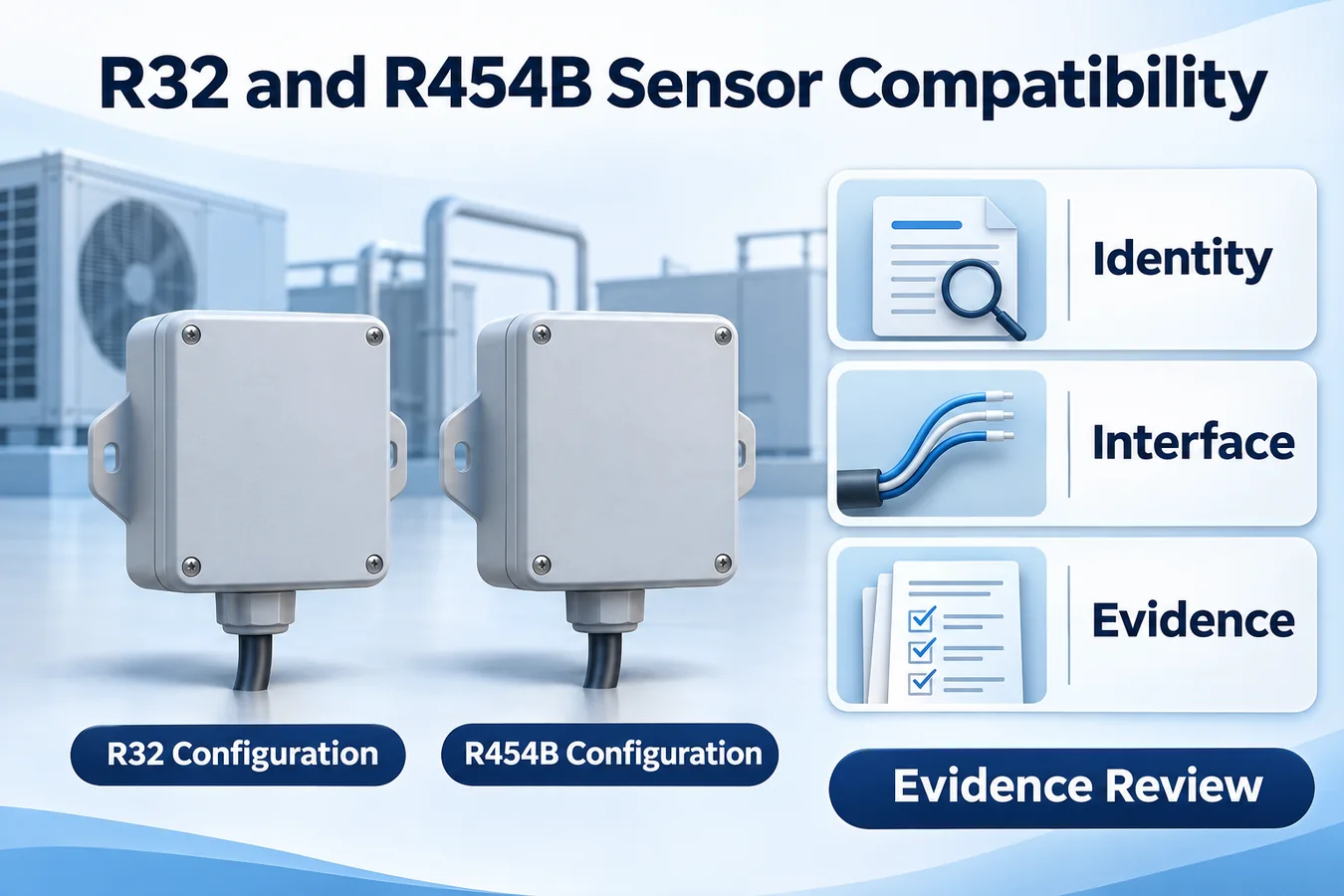
R32 vs R454B sensor interchangeability is a replacement-part decision. The proposed device must be identified and evaluated for a specific equipment configuration. Two modules may fit the same opening, use the same connector shell and appear under one product family name. That establishes useful mechanical information. The replacement decision also depends on the shipped gas configuration, calibration evidence, interface meanings and the appliance qualification record.
Start by recording the appliance model and serial number, the approved refrigerant, the current detector part and revision, and the proposed replacement’s full orderable identity. Compare the parts in the condition in which they will be shipped and installed. The examples below use hypothetical substitution records. Any field action follows the equipment manufacturer’s released parts information and service instructions.
Establish what the replacement decision covers
Define whether the request concerns an existing field unit, a supplier change for production or a manufacturer-approved replacement kit. These cases produce different evidence and release records. For a field unit, locate the exact approved replacement against the model and serial range, and check whether the relevant instructions require a particular installation or verification method. In production, identify which appliance construction, controls release and certification records the proposed part will enter.
A supplier may submit a new part under a commercial family code. Ask for the exact option string, suffix, hardware revision, firmware and configuration identity. Preserve the relationship between these identifiers and the OEM service part number. Identify any lot or serial boundaries. If the same service number covers several approved revisions, ask which document establishes that relationship and whether any revision needs a paired harness, board update or service instruction.
Separate a part substitution from a refrigerant conversion. The appliance refrigerant and charge information come from the approved equipment construction and its markings. The substitution review asks whether the proposed sensing device restores or implements that construction for the declared refrigerant. EPA’s SNAP tables identify refrigerant substitutes for defined end uses and list applicable use conditions. Use the relevant equipment and regulatory documents to establish the appliance boundary. EPA residential and light commercial air conditioning and heat pump substitutes
Match the exact part identity and delivered configuration
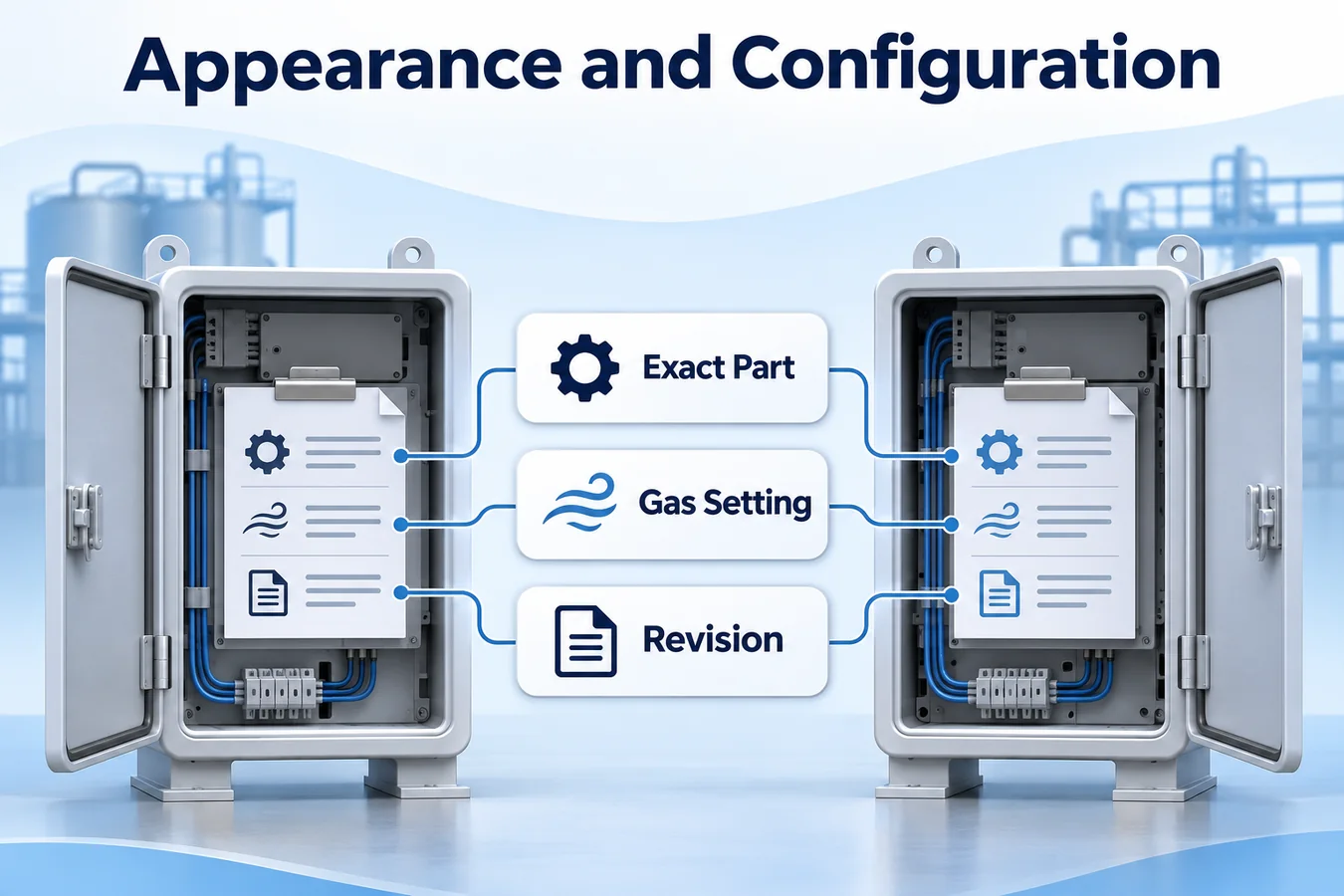
Compare permanent markings, packaging, purchase documentation and readable electronic identification where the design supplies it. Ask which field is authoritative when a carton and the device disagree. Photos of a featureless housing can establish appearance. A traceable purchase record or supplier certificate should tie the actual sample to the documented variant. Have receiving quality verify the identities and preserve the sample’s lot or serial number with the test record.
Define how gas identity is set. In a hypothetical family, the gas might be fixed by the order code, programmed at the factory or assigned through an approved OEM provisioning step. If a configurable device is proposed, establish the authorized setting method, default state, change control and readback procedure. Determine whether a service board replacement, firmware update or power interruption can affect the configuration. A test report should record the delivered state and any authorized changes before and after the evaluation.
Inspect the actual service unit and accompanying hardware. A cable that ships with one version may be absent from another. A connector latch may engage while the strain relief or conductor assignment differs. A new assembly may carry a marking on a face hidden after installation. Decide where the service record will capture the identifier and how the technician can confirm it before closing the cabinet.
Have the supplier explain any discrepancies between label, firmware readback and catalog. If the underlying order code resolves the difference, retain the controlled cross-reference. If evidence leaves the proposed variant ambiguous, record the release as pending. This lets purchasing and field support see what information is missing before a provisional part number enters an approved list.
Verify refrigerant identity and calibration evidence
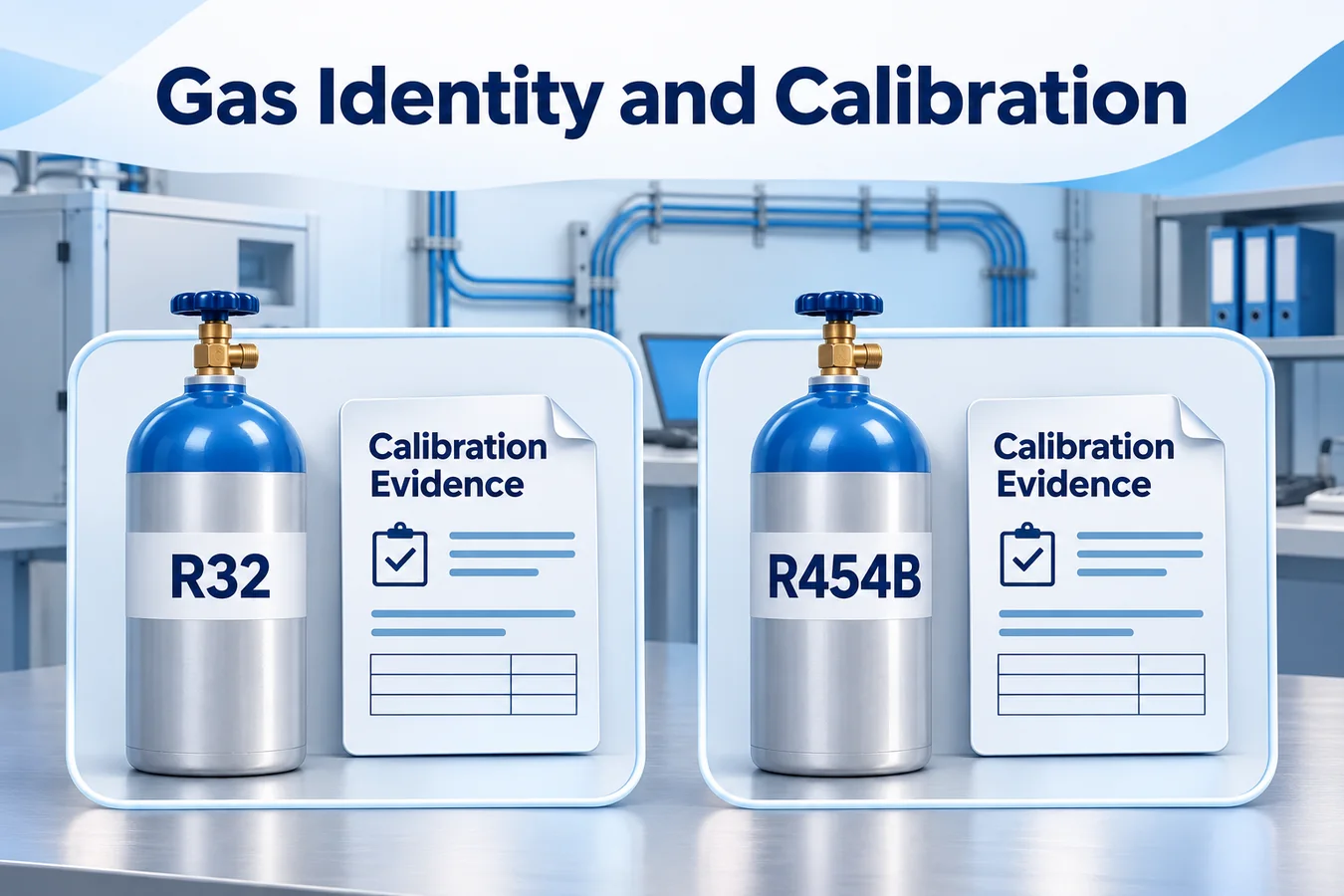
ASHRAE identifies R32 as difluoromethane and lists R454B as a blend of R32 and R1234yf. EPA lists both as A2L in the cited end-use table. The classification describes the refrigerant hazard category. A sensor reviewer still needs evidence that the supplied variant detects the equipment’s declared refrigerant and that the reported concentration or event is interpreted correctly. ASHRAE refrigerant designations EPA substitutes and safety classifications
Ask how the exact variant’s gas response is characterized, including the test gas identity, reference method, environmental range and how production units are verified. If output is expressed in units tied to lower flammability limit, confirm which refrigerant’s reference basis is used and where scaling is applied. If the module provides an alarm state, identify how that state is generated and communicated. Use the controlled data for the supplied variant and the acceptance criteria from the appliance program.
A family can offer both gases in dedicated variants or in a documented multi-gas implementation. If a supplier presents multi-gas evidence, verify that it applies to the full order code, configuration and firmware under review. Clarify what the system reports when detection conditions overlap, where relevant to the design. For each gas-related claim, record the report revision, tested sample identity and applicable conditions. This makes the evidence usable if an incoming part later carries a different suffix.
Review the evidence near the points that matter to the equipment. A bench response from one gas exposure shows what happened in those conditions. For qualification, ask how tolerance, recovery, environmental effects and applicable aging or drift evidence bear on the accepted appliance behavior. UL Solutions discusses drift and detection system evaluation in its overview of changes to the fourth edition of UL 60335-2-40 and related certification requirement decisions. Confirm the applicable test scope with the certification owner. UL Solutions refrigerant detection system requirements overview
Compare the mounting and exposure details
Put both controlled drawings and samples beside the approved bracket. Compare attachment, enclosure clearances, inlet location and orientation, harness length and routing, and any protective parts that influence gas access. The same footprint can place an opening behind a lip or place the cable against a cover. Record dimensional and assembly differences in the substitution review with photographs or annotated sections tied to the correct drawing revisions.
Check the installed state through assembly and service. Look for opportunities to pinch a harness, cover an inlet or omit a shield supplied with the original part. If the candidate requires a different bracket or route, treat the proposal as a kit or construction change and identify its effect on the equipment evidence. Confirm the instructions tell the technician how to identify and restore the approved assembly.
The decision should also account for tolerance and environmental exposure. Compare the candidate’s relevant operating assumptions with the location in the unit, including moisture exposure, condensation conditions and likely cleaning or service contact, as appropriate. Document which aspects are supported by supplier evidence and which require installed evaluation. If the assembly is shared across several cabinet sizes, state the boundary of the comparison for each size affected.
Compare electrical behavior and protocol semantics
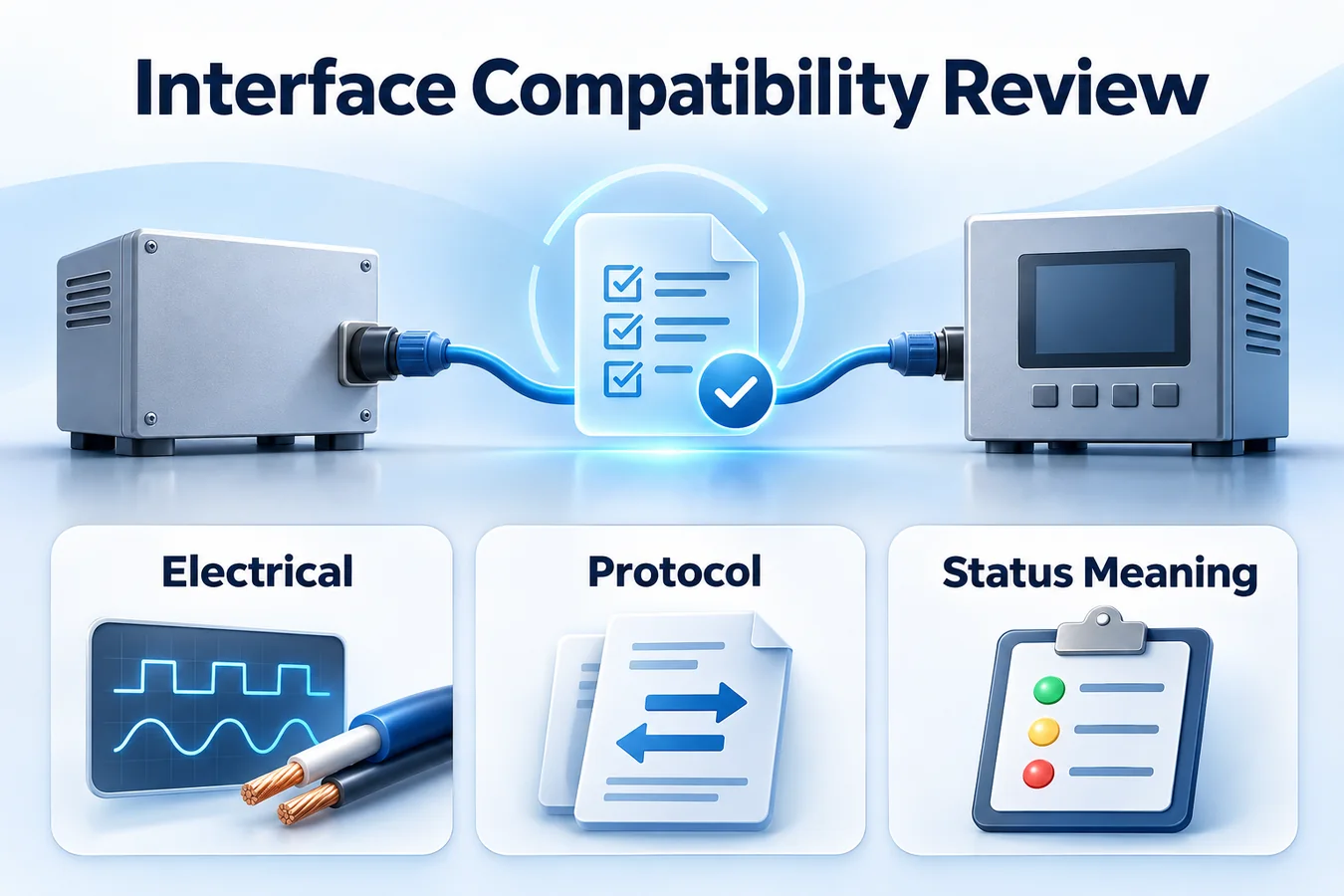
Use the equipment and supplier drawings to review connector assignment, supply requirements, startup load, grounding and interface electrical characteristics. If the product uses a serial interface, compare addressing, framing, timing, message mapping and how invalid or stale data is identified. Matching connector fit and communication family answer only part of the question. The equipment controller has to interpret the exact messages and electrical states emitted by the device.
Build an interface comparison table with one row per controller decision. A gas event, a detector internal fault, a communications fault, a startup state and a valid low reading each need their own meaning. Record how the released controller interprets each input and how the candidate produces it. Verify whether a missing message, invalid value or warmup period can be mistaken for a healthy reading. Where status and concentration are reported together, establish their priority in the released software.
Check recovery as well as steady operation. With the qualified test setup, observe behavior during initialization, a sensor reset while the controller remains powered, interruption of the interface and restoration of communication. Capture both the raw device status and the resulting equipment actions. Retain the controller software revision in the test record so a later service team can identify whether the result applies to older units.
An interface adapter or firmware update changes the proposed construction. If the candidate works only with a new controller build, identify which serial ranges can accept that combination and how the pairing will be verified. The approval record should name the paired hardware or software and link to the controlled service method when applicable. This prevents a successful test on a development controller from being applied to units still running another build.
Set the appliance qualification boundary
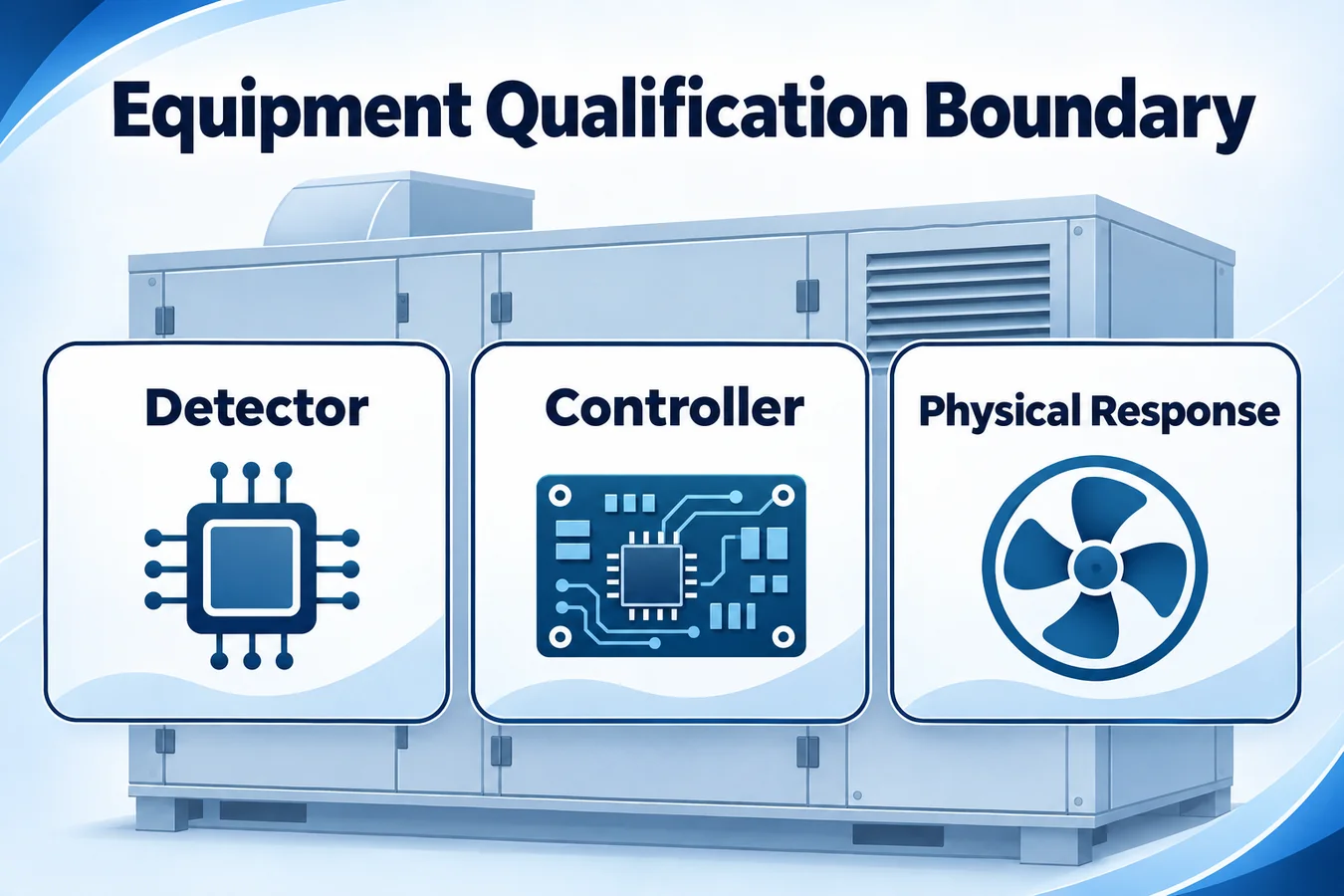
A supplier’s detector evidence and the appliance qualification record answer different questions. The component evidence identifies properties of the supplied module under specified conditions. The appliance record ties the installed detector, equipment control logic and physical response to the approved construction. UL Solutions explains that an integral refrigerant detection system is evaluated as part of HVAC equipment certification when required, and points to the equipment instructions for the specific installation and mitigation behavior. UL Solutions inspection guidance for integral refrigerant detection systems
Build an impact comparison starting from the released appliance record. For each change, ask whether the evidence depends on sensor location, gas response, timing, controller interpretation or a downstream actuator. A different inlet position may change the transport evidence. Different fault encoding may change response when communication is interrupted. Changes that affect more than one link should be visible to the owner of each test.
Give the certification owner the exact comparison and proposed basis for carrying results forward. When the program calls for additional tests, record the applicable configuration and objective. A production approval, a service-kit approval and an authorized parts supersession should each be traceable to the decision supporting that use. If approved coverage is narrower than the appliance family, preserve that boundary in parts lookup and service documents.
Use the approved service replacement path
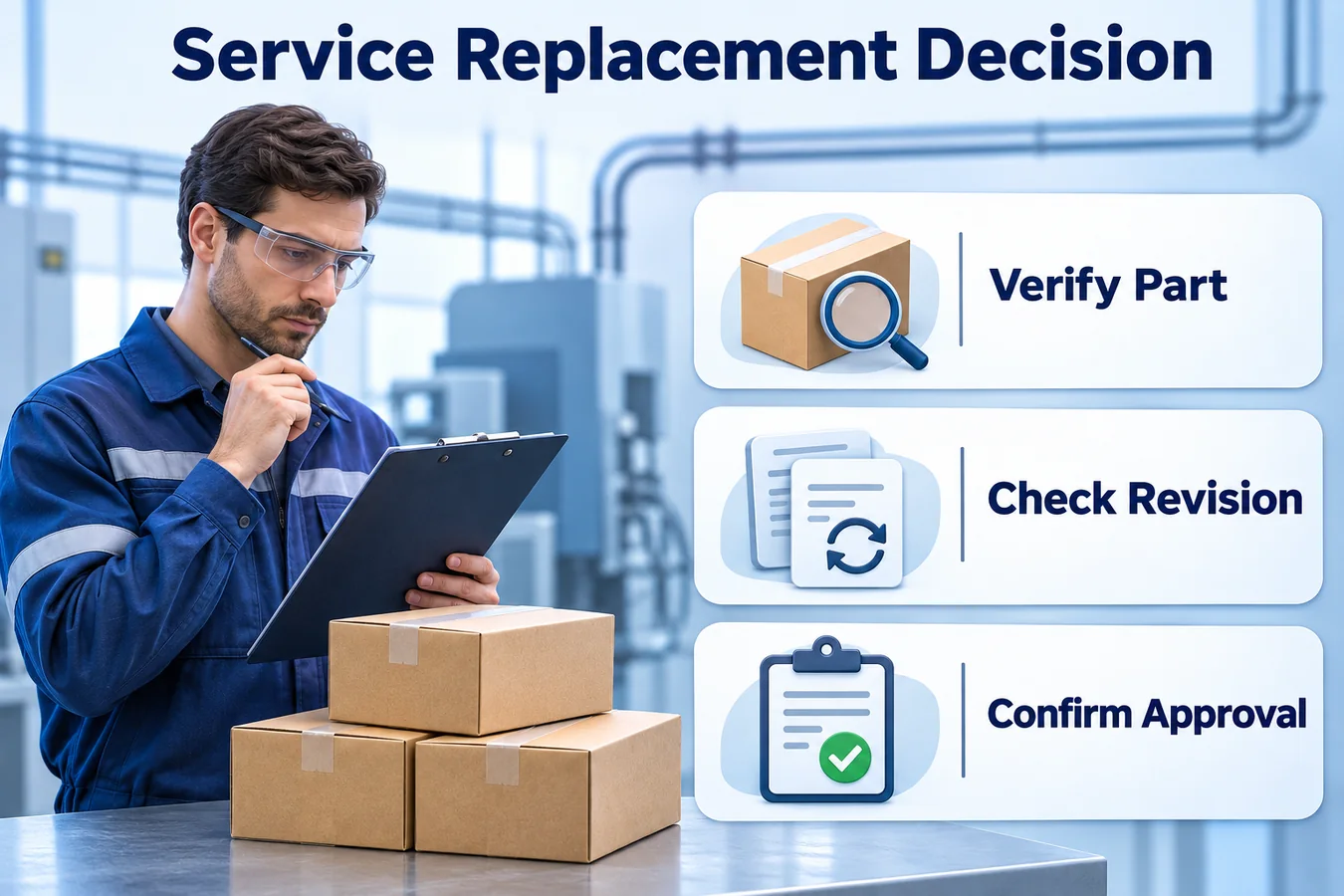
For service, capture the appliance model, serial number and refrigerant before consulting the parts information. Identify the installed component, any approved supersession and the required associated hardware. Confirm the replacement identity from the package and part markings using the manufacturer’s instructions. If a repair involves a prescribed system verification, record its outcome with the work order. A normal display in idle operation covers only the state that was observed.
Daikin’s published R32 equipment installation manual provides an example of how this works. Its refrigerant detection system service section directs technicians to use specified replacement sensors and gives the exact replacement identifier for the covered equipment. It also distinguishes sensor faults from communication faults in the service information. Use the part and procedure released for the actual appliance. Daikin R32 equipment installation and service manual
If purchasing offers a replacement based on a visual cross-reference, collect its evidence and route it through the appliance manufacturer’s technical approval process. Record why it was offered, the relevant source documents and the exact approved unit population once the decision is made. Where the field system uses multiple approved kits, have the service lookup make model and serial applicability easy to confirm before the part is ordered.
Put the substitution evidence in a matrix
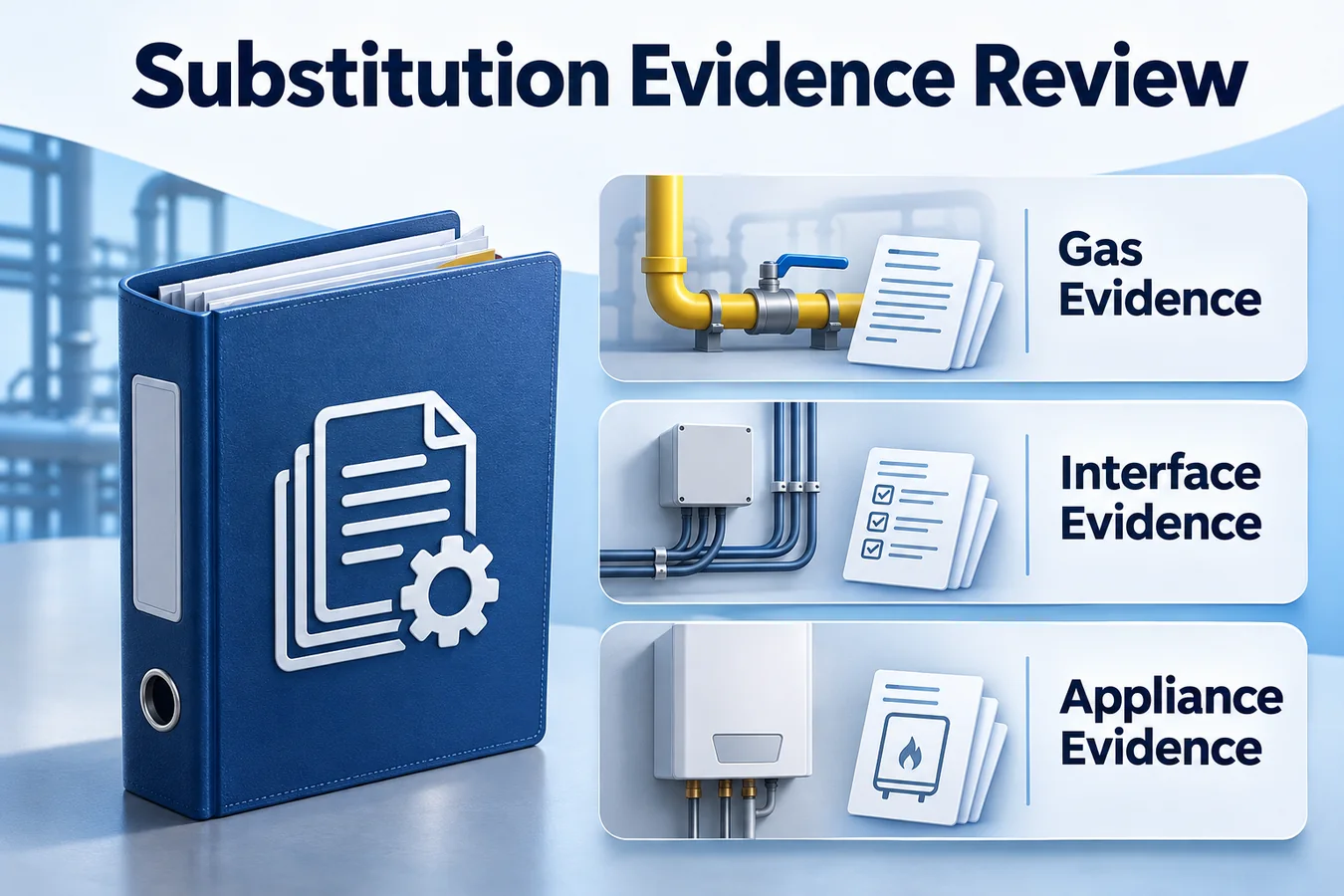
The matrix below shows an illustrative review for an R454B appliance. Candidate X resembles the released part but lacks gas configuration evidence. Candidate Y has a traceable gas configuration with an interface revision still under review. Neither row represents an approval for an actual product.
| Comparison | Candidate X evidence | Candidate Y evidence | Decision owner |
|---|---|---|---|
| Exact part and revision | Family label and carton photo | Order code, device label and firmware identified | Supplier quality |
| Gas and calibration | Gas selection absent from supplied evidence | R454B report tied to delivered configuration | Sensor engineering |
| Mechanical installation | Envelope compared, inlet location open | Controlled drawing and bracket sample compared | Mechanical engineering |
| Controller status mapping | Electrical fit offered, semantic mapping absent | Normal messaging observed, restart behavior open | Controls engineering |
| Appliance release | No supporting appliance record provided | Equipment verification scope under review | Product safety and certification |
Add links to the actual drawings, controller test traces and approved service instruction revisions. Give each unresolved cell a question, owner and next evidence item. If a candidate is eventually approved for a limited population, add the affected serial range and required paired hardware to the release. Preserve the supersession history so that a future reviewer can tell which candidate was evaluated and which was shipped.
Verify the full path with identified samples
Start the evaluation with incoming identification and configuration readback, where available. Then review the mechanical installation, interface behavior and appropriate gas response evidence before verifying the assembled equipment. Use approved laboratory methods and record the test setup, reference instruments, control build, sample identity and operating conditions. Choose scenarios from the approved equipment requirements and the change assessment.
A controller bench test can use representative input to exercise event and fault handling. A detector test can establish how an identified sample responds to the specified exposure under the conditions tested. Installed testing, where applicable, checks the relationship between cabinet transport, detection and physical response. Record the evidence at each stage so reviewers can distinguish controller behavior from installed gas transport or an actuator problem.
Capture a time-aligned trace of the relevant input and equipment outcome. Note which actions are confirmed by physical measurement or feedback. Review evidence for normal initialization, expected response, unavailable data and return to the released operating state. If one step requires a new harness or software configuration, link its test record to the resulting combination. This gives manufacturing and service a basis for verifying that the approved configuration was actually installed.
Control procurement, service stock and supersession
Keep supplier identity and OEM identity in the same change record. A purchase order should carry the full approved configuration or a controlled key that resolves to it. Receiving checks should recognize the identifiers and lot or serial fields needed for traceability. If similar-looking variants are stocked together, use the released labels and records to prevent a physically matching but unapproved part from reaching an appliance.
Set the effective point for each change. An approved production change may begin with a build date or serial range. A service supersession may require an additional harness or software level. Record how existing inventory, returns and units in the field map to the approved identifiers. Ask who will update the bill of materials, service lookup and instructions, and who can authorize an exception when the documented parts path fails.
When a supplier changes the device label or firmware, determine whether the evidence still refers to the delivered construction. Reopening the specific affected matrix cells is more useful than treating the whole part as new or automatically carrying the old approval forward. Preserve a readable comparison between the two revisions and trace its conclusion to the relevant verification and release records.
Work through a suffix change before releasing the part
Suppose a supplier proposes an end-of-life replacement for an R454B detector used in a packaged unit. The replacement ships in the original housing and fits the bracket. Its order suffix changes, and its revision note says that power-up reporting was revised. A reviewer can accept the bracket comparison as evidence about fit while keeping the electrical, gas and equipment questions open. Ask whether the gas configuration and calibration report apply to the new suffix. Obtain a state-by-state description of the reporting change, and identify which released controller builds will encounter it.
An engineering sample of the replacement then reports a valid-looking value during initialization. If the released controller uses a separate readiness field, verify that the field stays authoritative until the sensor is ready. If an earlier controller build relies on a different startup behavior, verify that build separately or restrict the proposal to the combination that was demonstrated. Define the release against evidence for the actual version pair. Purchasing and service need a lookup that makes the approved combination visible when either component is ordered.
If the supplier proposes a field-configurable candidate, include how the released service process identifies its delivered state and confirms the resulting state after authorized provisioning. The appliance approval should specify which procedure and tooling are within scope. Check who can verify the result when the part is subsequently replaced again. The point of the comparison is to preserve the correct gas and interface configuration through the full service life.
Close the decision with a traceable disposition
Document the decision in a form that the parts team can use. Include the original and proposed order codes, the affected appliances, any paired components or software, and the effective range. Link the controlled verification and approvals for each accepted construction. Keep a pending decision out of the released service lookup until the applicable release owner has signed off.
Record test limitations in the comparison. A test performed with an R454B configuration has a declared gas scope. A bench with one controller revision has a declared interface scope. A test on a particular cabinet and mounting arrangement has a declared installation scope. If a service population spans several versions, explain which evidence covers each one and how the field will distinguish them.
When the parts group receives an ambiguous candidate, give the supplier the exact missing artifact to resolve. A controlled variant mapping may settle identity. A revision-specific state table may settle which bench cases are needed. The resulting disposition should be understandable to the engineer who repeats the review after the next supplier change.
Use a worked sample at the change review to check that the manufacturing and service teams can follow the disposition. Give each reviewer a representative appliance identity and the proposed replacement label. Ask them to locate the approved part and any required paired revision using the released information. If the two groups reach different conclusions, locate the ambiguous part number or revision reference and correct the controlled records before release. Include photographs of the approved markings where they help distinguish physically similar assemblies. If a replacement arrives with an unexpected label, the process should give the technician a clear route to confirm its identity with the appliance manufacturer.
Ofte stilte spørsmål
Can an R32 sensor be used in R454B equipment if it detects both gases in a bench test?
Use the appliance manufacturer’s approved replacement list and applicable service instructions. A bench observation can support one aspect of a qualification program. The program also needs the exact variant’s gas configuration, interpretation and installed equipment evidence for the proposed use.
Does the same connector make two sensor revisions compatible?
Connector fit establishes a mechanical relationship. Review electrical behavior, assignment, protocol and status meanings for the actual pair. Verify what the equipment does when the sensor is initializing, faults or becomes unavailable.
Can a multi-gas catalog listing serve as proof of approval?
A catalog listing identifies candidate applications at the family level. Ask for the supplier evidence that applies to the exact delivered variant and compare it with the appliance approval or change record. The equipment manufacturer’s approved service information governs the field replacement.
What should the service record capture?
Record the appliance identity, original and replacement parts, revisions where available, and the approved instructions or supersession used. Document the prescribed post-service verification and record any paired harness or controller change that forms part of the released repair.
Evaluate a ZRT512C-A candidate with the OEM team

Winsen lists the ZRT512C-A as an NDIR refrigerant detection module family with R32 and R454B among its target gases and describes available output options. Evaluate the exact orderable variant as a candidate. Request the controlled drawing, gas and calibration evidence, interface specification, firmware identification and environmental data for the supplied configuration. Compare that package with the appliance requirements and qualification evidence before making a substitution decision. Winsen ZRT512C-A manufacturer specification ZRT512C-A product page
For an OEM review, share the declared refrigerant, current and proposed part identities, equipment and controller revisions, and the specific reason for the substitution. Include the evidence matrix and the approval boundary you need, such as one production construction or a defined service population. Ask for traceable documentation and samples tied to the exact orderable configuration being considered. Contact the refrigerant sensor team
