
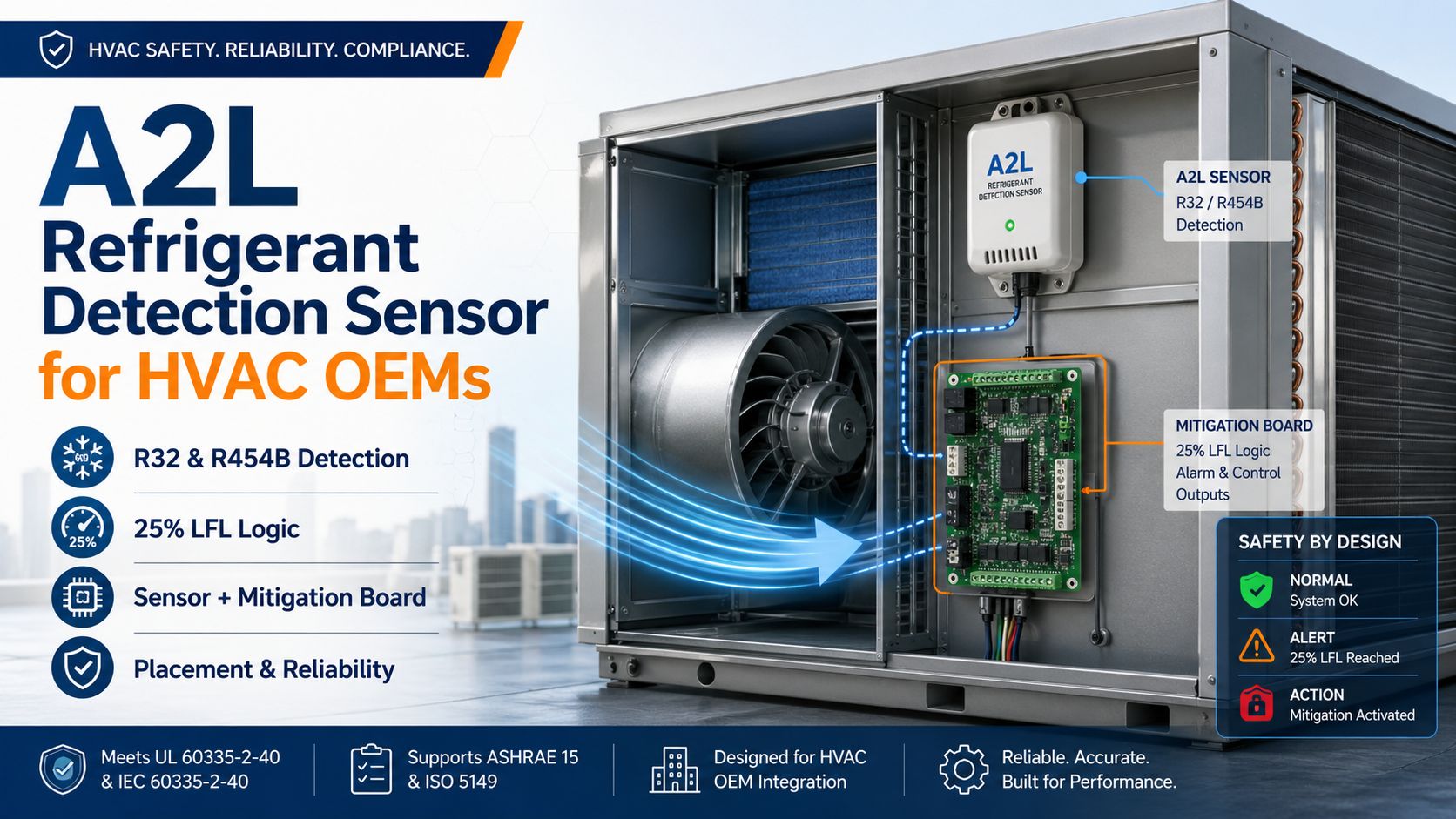
O que “A2L” significa para design OEM
Ashraea estrutura de classificação de segurança define a subclasse 2L para refrigerantes que têm uma velocidade máxima de queima de 10 cm/s ou menos, razão pela qual os refrigerantes A2L são tratados como levemente inflamáveis, em vez de equivalentes aos hidrocarbonetos A3.
No desenvolvimento real de produtos HVAC, essa classificação altera os requisitos do detector. A orientação de refrigerante de baixo GWP da UL diz que o sistema de detecção de vazamento deve ser ativado abaixo de 25% do LFL, proporcionando um fator de segurança quatro vezes maior, e que os sistemas de detecção ativem dispositivos de mitigação, como ventiladores de circulação. A orientação de projeto A2L da TI afirma da mesma forma que o sistema de detecção de refrigerante deve produzir saída dentro 30 segundos de exposição direta a 25% LFL.
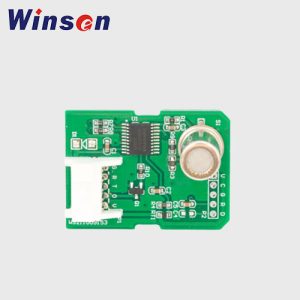
Desenvolvido em conjunto por Winsen e TI: https://refrigerantsensor.com/zrt512c-r454b-4-ti-refrigerant-sensor-module/
Como funciona um sistema de detecção de refrigerante A2L em equipamentos HVAC
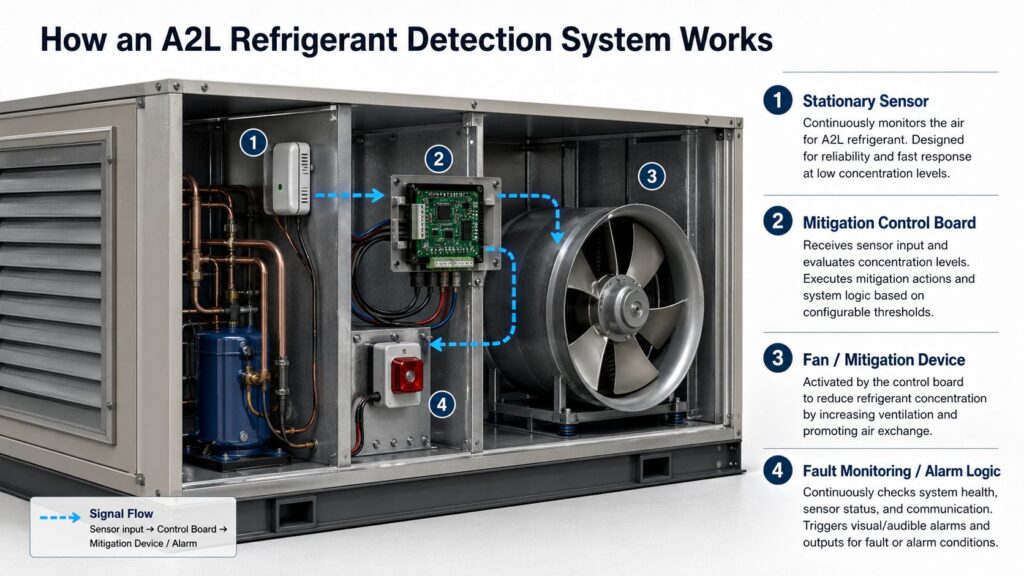
Uma implementação OEM típica possui quatro camadas:
1. Sensor estacionário
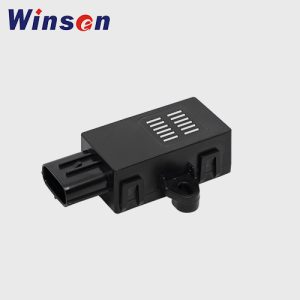
O sensor monitora continuamente o ar no gabinete, na corrente de ar ou na provável zona de acúmulo de vazamento. A UL afirma que um RDS integral utiliza um ou mais sensores estacionários e deve ser instalado no equipamento HVAC de acordo com as instruções de instalação do fabricante.
2. Painel de controle de mitigação
A orientação de mitigação A2L da TI mostra o módulo do sensor fazendo interface com uma placa de mitigação. Com base na detecção de refrigerante, ou na falta dele, o conselho realiza ações de mitigação conforme necessário.
3. Dispositivos de mitigação
A UL afirma que essas ações de mitigação podem incluir dispositivos como ventiladores de circulação. Em implementações OEM em campo, a placa também pode sinalizar um sistema de gerenciamento predial ou mudar a unidade para um modo de dissipação definido. O guia suplementar da Carrier, por exemplo, descreve o sensor de refrigerante comunicando-se com uma placa de dissipação que aciona a ação do ventilador e a sinalização BMS quando a concentração excede uma porcentagem definida de LFL.
4. Supervisão e tratamento de falhas
O detector faz parte de uma função de segurança, portanto, o tratamento de falhas do sensor é quase tão importante quanto a própria detecção de vazamentos. Os requisitos atualizados da UL enfatizam explicitamente a robustez ao longo da vida, e a TI enquadra o projeto de mitigação A2L como um problema de controle, não apenas um problema bruto de detecção.
Erros comuns de OEM
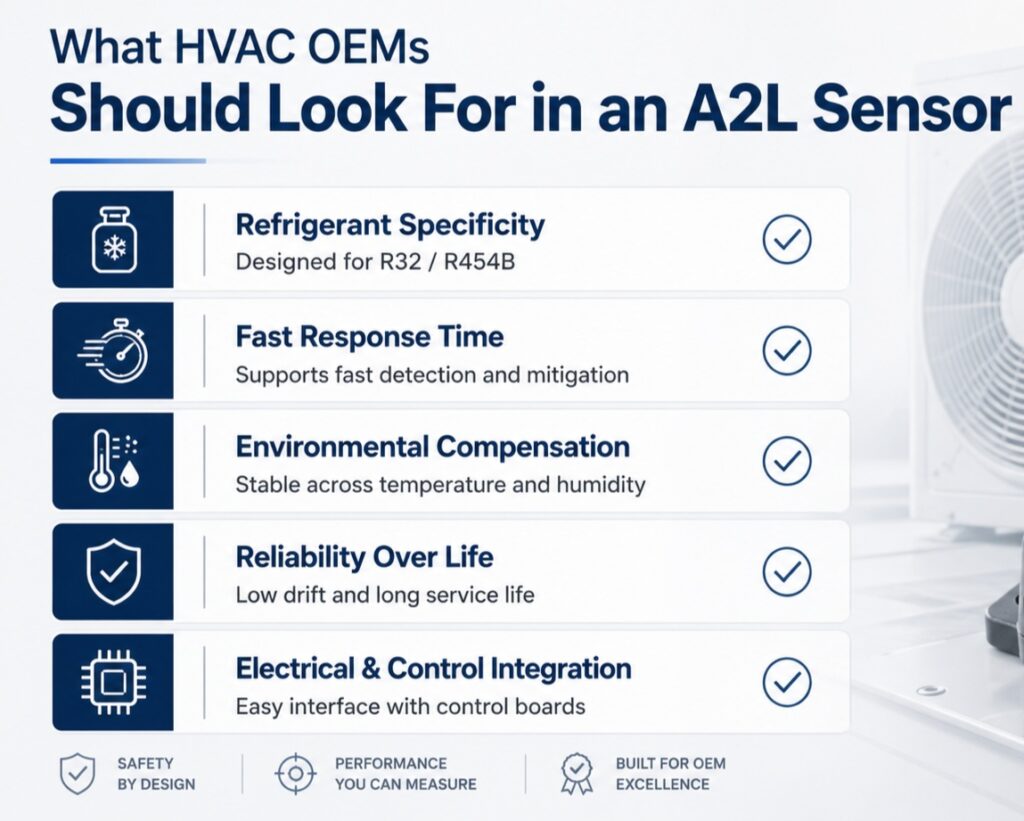
Um erro comum é escolher um detector como se fosse um sensor genérico de gás combustível. As aplicações A2L HVAC estão vinculadas a limites específicos de refrigerante, lógica de mitigação e requisitos de ciclo de vida, portanto, uma declaração genérica de sensor geralmente deixa muito trabalho de validação para o OEM.
Outro erro é otimizar apenas a sensibilidade do laboratório, ignorando a condensação, os contaminantes, o desvio de longo prazo e o tratamento de falhas de campo. A ênfase em evitar o ponto de orvalho da Danfoss e as afirmações de autoteste e resistência a venenos da NevadaNano refletem a mesma realidade: os gabinetes HVAC não são ambientes de laboratório limpos.
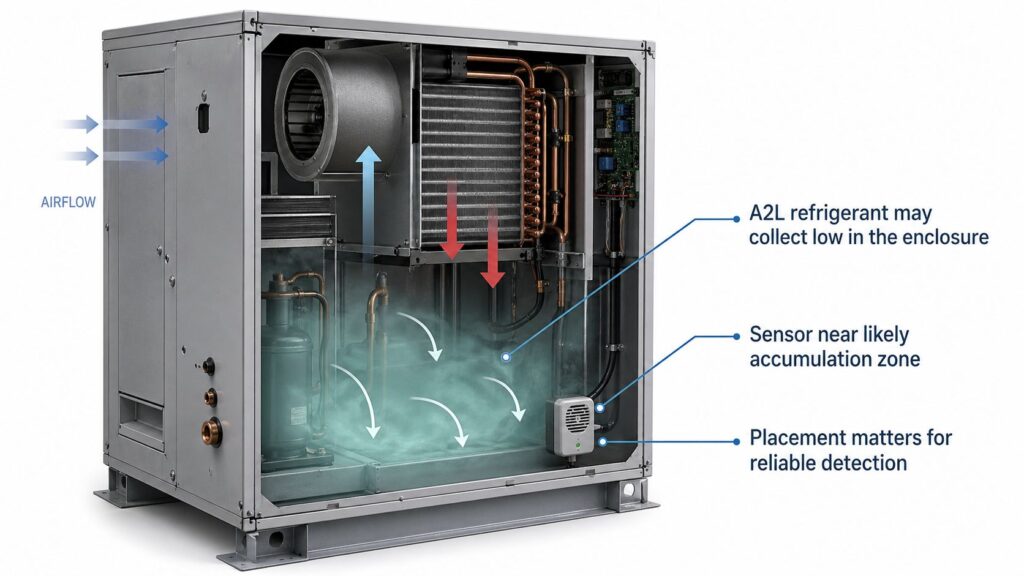
Um terceiro erro é tratar a colocação como um detalhe mecânico tardio. A orientação da UL sobre a coleta de refrigerante próximo à parte inferior do gabinete mostra por que a localização do sensor precisa fazer parte do gabinete e do projeto do fluxo de ar desde o início.



Perguntas frequentes
O que é um sensor de detecção de refrigerante A2L?
É um sensor de gás estacionário ou módulo de sensor usado em equipamentos HVAC para detectar refrigerantes A2L levemente inflamáveis em uma concentração especificada e apoiar ações de mitigação exigidas pelo padrão de segurança aplicável.
Por que os OEMs de HVAC precisam de sensores A2L?
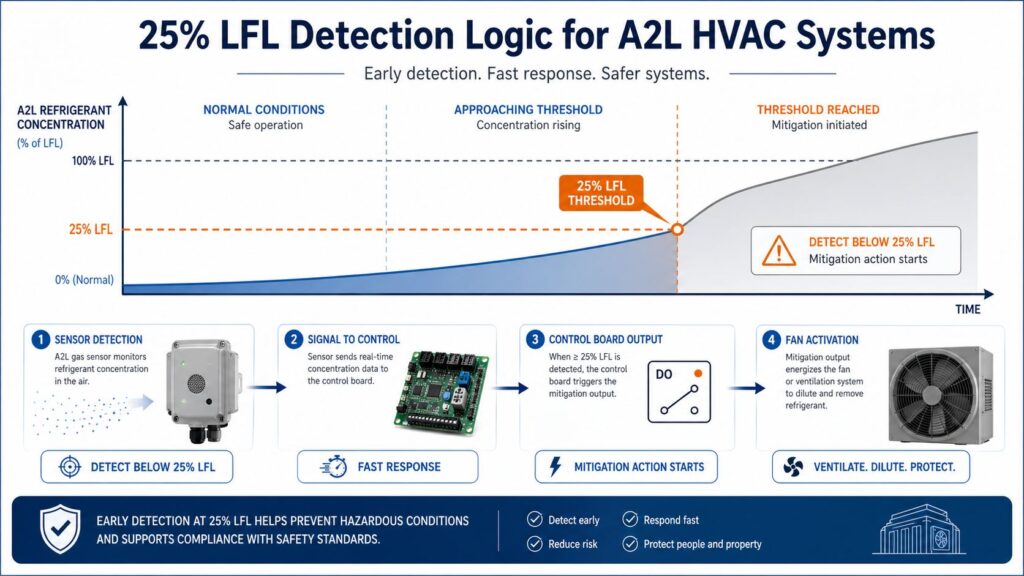
Como os refrigerantes A2L apresentam inflamabilidade moderada e a orientação da UL exige que o sistema de detecção de refrigerante seja ativado abaixo 25% do LFL e apoiar ações de mitigação, como operação de ventiladores.
Quais refrigerantes são mais comuns para detecção de HVAC OEM A2L?
Em HVAC, os exemplos mais comuns são R32 e R454b, que são os alvos específicos do sensor HVAC DST G200 da Danfoss.
Com que rapidez um sensor A2L deve responder?
Os valores específicos do produto variam, mas a TI diz que o RDS produzirá resultados dentro 30 segundos de exposição direta a 25% LFLe listas Danfoss menos de 15 segundos tempo de resposta para DST G200.
Onde o sensor deve ser instalado?
A UL afirma que os refrigerantes A2L são mais pesados que o ar, portanto, os sensores são normalmente colocados onde o refrigerante vazado pode afundar e se acumular, geralmente próximo à parte inferior do gabinete.
Os OEMs precisam apenas de um sensor ou de um sistema de mitigação completo?
Isso depende da plataforma. Alguns OEMs integram um módulo de sensor em sua própria placa de controle, enquanto outros usam um sistema mais amplo de detecção de refrigerante com lógica de controlador de mitigação e saídas de relé.

Comentário (1)
[…] background on system architecture, see our A2L refrigerant detection guide, RDS guide for R32 and R454B equipment and NDIR versus MOS […]