
When you work with combustible gas detection—natural gas (methane), LPG (propane/butane), hydrogen, or hydrocarbon vapors—you’ll repeatedly see two units:
- %LEL (Percent of the Lower Explosive Limit)
- %Vol (Percent by Volume in air)
They look similar, but they answer different safety questions. This guide explains what each means, and how to choose the right unit for alarms, ventilation control, or OEM gas detector product design.
What Does %LEL Mean?
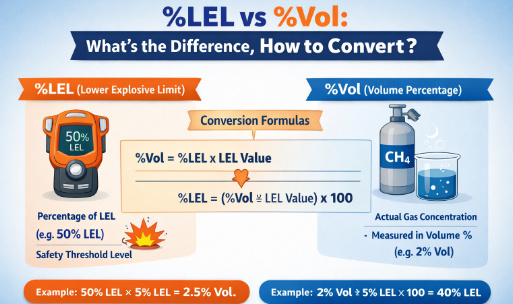
%LEL tells you how close the atmosphere is to the ignition threshold (LEL).
- 0% LEL = no combustible gas detected (or below instrument resolution)
- 100% LEL = the mixture has reached the Lower Explosive Limit (minimum concentration that can ignite)
- 10–20% LEL = commonly used as early warning/alarm zone in many safety practices (exact setpoints depend on local codes and risk assessment)
Why %LEL is popular in safety systems
Because it directly supports decisions like:
- Start ventilation
- Trigger alarms
- Shut off valves / stop processes
- Evacuate or stop work
In short, %LEL is a safety scale.
What Does %Vol Mean?
%Vol (percent by volume) is the actual concentration of gas in the air mixture.
Example:
- 1%Vol methane means methane makes up 1% of the air volume.
Why %Vol is important
%Vol is preferred when you need:
- Process monitoring (biogas, methane-rich streams, production lines)
- High-concentration measurement ranges
- Engineering calculations (ventilation sizing, mass balance, trend analysis)
- Clear “absolute value” reporting across systems
In short, %Vol is an absolute concentration scale.
The Key Difference (Simple Summary)
- %LEL answers: “How close am I to the ignition threshold for this gas?”
- %Vol answers: “What is the actual concentration in the air?”
Both are useful—but for different goals.
%LEL ↔ %Vol Conversion Formulas
You can convert only if you know the gas’s LEL (%Vol).
1) Convert %LEL to %Vol
Gas(%Vol) = (%LEL / 100) × LEL(%Vol)
Equivalent:
Gas(%Vol) = %LEL × LEL(%Vol) / 100
2) Convert %Vol to %LEL
%LEL = (Gas(%Vol) / LEL(%Vol)) × 100
Worked Examples (Most Common)
Example A: Methane (CH4)
Typical methane LEL is often listed around 5%Vol.
- If reading = 10%LEL
Gas(%Vol) = 10 × 5 / 100 = 0.5%Vol - If reading = 25%LEL
Gas(%Vol) = 25 × 5 / 100 = 1.25%Vol - If methane = 1%Vol
%LEL = (1 / 5) × 100 = 20%LEL
Example B: Propane (C3H8)
Typical propane LEL is often listed around 2.1%Vol.
- If reading = 10%LEL
Gas(%Vol) = 10 × 2.1 / 100 = 0.21%Vol - If propane = 0.5%Vol
%LEL = (0.5 / 2.1) × 100 = 23.8%LEL (approx.)
ppm vs %Vol (Quick Conversion)
This is useful when a product spec uses ppm while safety logic uses %LEL or %Vol.
- ppm = %Vol × 10,000
- %Vol = ppm / 10,000
Example:
- 0.5%Vol = 0.5 × 10,000 = 5,000 ppm
- 2,000 ppm = 2,000 / 10,000 = 0.2%Vol
When to Use %LEL vs %Vol
Use %LEL when your goal is explosion prevention
Best for:
- Fixed combustible gas detectors in boiler rooms, kitchens, mechanical rooms
- LNG/LPG safety monitoring (with correct gas calibration)
- Alarm/interlock logic (ventilation, shutoff, ESD)
Why: %LEL is directly tied to ignition risk thresholds.
Use %Vol when your goal is process or high-range measurement
Best for:
- Biogas digesters, landfill gas, methane-rich environments
- Process control where concentration can exceed LEL quickly
- Engineering analysis and trend monitoring
Why: %Vol remains meaningful across a wider range (and is easy to interpret as absolute concentration).
Common Mistakes
Mistake 1: Converting without confirming the gas LEL
Different gases have different LEL values. If you assume methane’s LEL for propane (or vice versa), your conversion will be wrong.
Fix: Always store LEL(%Vol) per gas in your documentation or UI.
Mistake 2: %LEL readings depend on calibration gas
Many detectors display %LEL based on a specific calibration gas (often methane). If the real gas is propane, butane, or a mixture, the displayed %LEL can be biased unless your device supports gas selection or correction factors.
Fix: Provide gas profiles in firmware/software or specify the calibration gas clearly in user docs.
Mistake 3: Treating “above UEL” as safe
A “too rich” mixture may not ignite immediately, but as it mixes with air it can pass back through the flammable range.
Fix: Use conservative response logic and control ignition sources whenever abnormal concentrations are present.
Mistake 4: Confusing ppm-level leak indication with explosion safety
Low ppm methane may indicate a leak, but it’s far from LEL. Conversely, %LEL alarms are about explosion risk, not trace leak surveying.
Fix: Align sensors and units with your goal: leak detection vs safety shutdown.
Practical Alarm Strategy (Typical Two-Stage Approach)
Many systems use two alarm levels (site-specific requirements vary):
- Low alarm: early warning → ventilation + notify
- High alarm: urgent → shutoff + stop ignition sources + evacuate response
If you design products (alarms/controllers/IoT gateways), it’s best practice to document:
- the measurement unit (%LEL or %Vol)
- calibration gas
- alarm thresholds
- required actions per threshold
FAQ
Is %LEL the same for every gas?
No. %LEL is a relative scale tied to each gas’s LEL. A 10%LEL reading represents a different %Vol for methane vs propane.
How do I convert %LEL to %Vol?
Use: Gas(%Vol) = (%LEL / 100) × LEL(%Vol)
Why do many detectors show %LEL instead of %Vol?
Because %LEL directly communicates how close you are to the ignition threshold, which is ideal for alarms and shutdown logic.
Can I use %Vol for safety alarms?
Yes—if your safety program is designed around absolute concentration thresholds. But %LEL is more common because it maps directly to flammability.
How do I convert %Vol to ppm?
ppm = %Vol × 10,000
OEM Tip: Make This a “Feature” in Your Product UI
If you manufacture gas alarms, transmitters, or IoT monitoring devices, a clean UI/labeling strategy is a competitive advantage:
- Show %LEL for safety actions
- Optionally show %Vol (and ppm) for diagnostics/trending
- Clearly label calibration gas and conversion logic
