
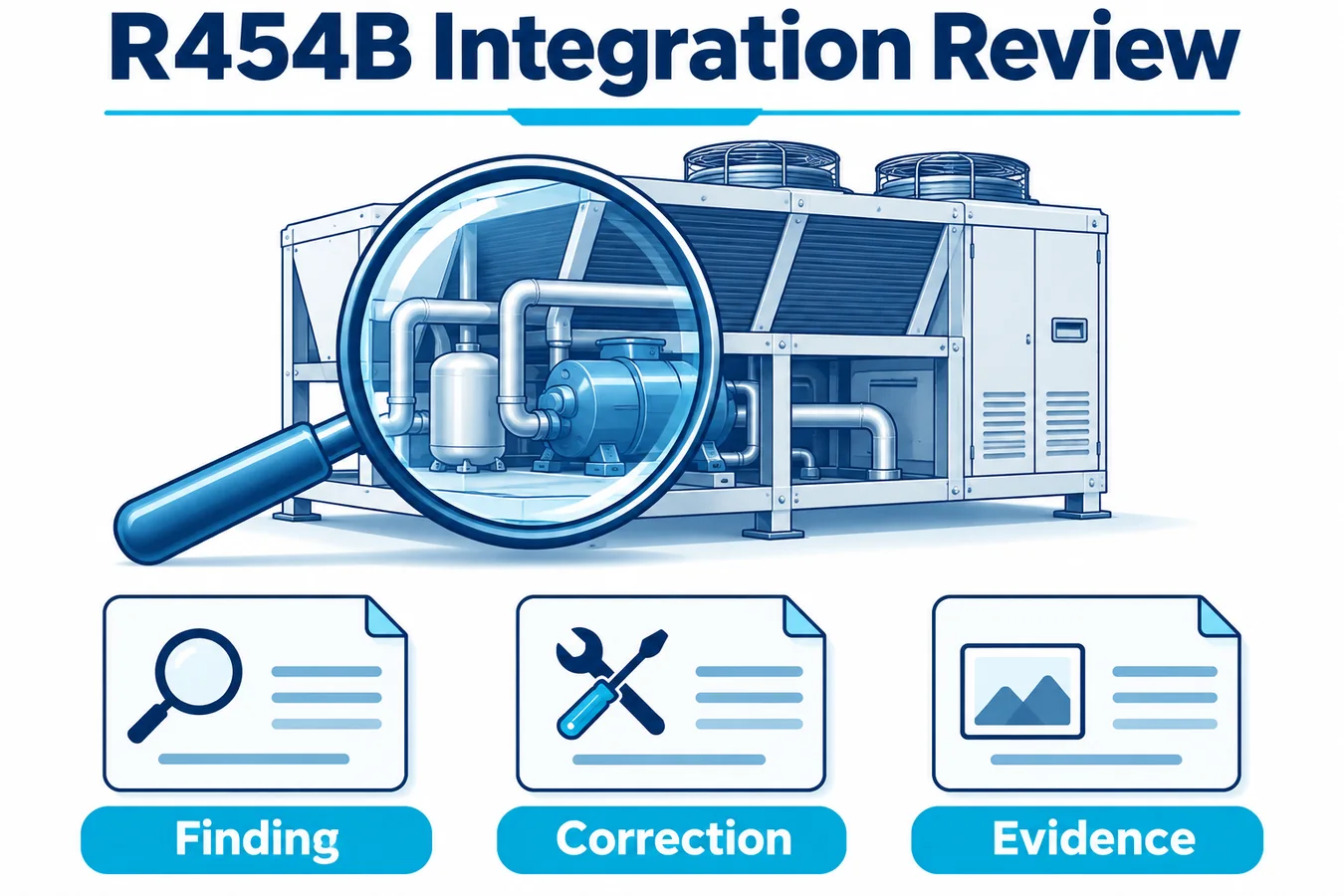
R454B sensor integration mistakes often become visible where two teams’ assumptions meet. A mechanical drawing shows a bracket that the transport test never used. A controller receives the expected alarm message while the credited fan action remains unobserved. A procurement description names the right product family but omits the suffix that identifies the intended assembly. Each finding needs a defined correction and evidence tied to the configuration that will enter production.
The review cases below are illustrative engineering scenarios. They describe how to write, investigate and close findings without claiming a failure rate or attributing incidents to a particular manufacturer. Use the applicable equipment evaluation, manufacturer instructions and approved test methods to determine the actual acceptance criteria for a project.
UL Solutions explains that an integral refrigerant detection system, when required, is evaluated as part of HVAC equipment certification. Its inspection guidance points to manufacturer instructions for the specified RDS, installation details, wiring and equipment actions. That relationship makes the complete installed configuration the useful boundary for a design review. റഫ്രിജറൻ്റ് ഡിറ്റക്ഷൻ സിസ്റ്റങ്ങൾ പരിശോധിക്കുന്നതിനുള്ള UL സൊല്യൂഷൻസ് മാർഗ്ഗനിർദ്ദേശം
Write findings so another engineer can reproduce them
A finding should identify the reviewed configuration, the expected relationship, the observed discrepancy and the missing evidence. Include the equipment drawing, module assembly, harness, controller release and test record where they affect the issue. Replace a broad statement such as “sensor integration incomplete” with a specific observation about the configuration or test scope. A reviewer should be able to locate the same discrepancy without attending the original meeting.
Separate observation from hypothesis. For example, a missing event in a controller log is an observation. Lost communication, an unsupported diagnostic code and a wrong channel mapping are possible explanations. Preserve the record that shows the symptom and assign the investigation before approving a proposed fix. This prevents the team from closing a finding after changing the most convenient component without establishing what failed.
State the evidence required for closure in the initial record. It may include a corrected drawing, supplier clarification, configuration readback or a retest on an identified specimen. If the investigation changes that requirement, update the finding and retain the reason. The closure record should explain why the evidence now supports the intended equipment claim.
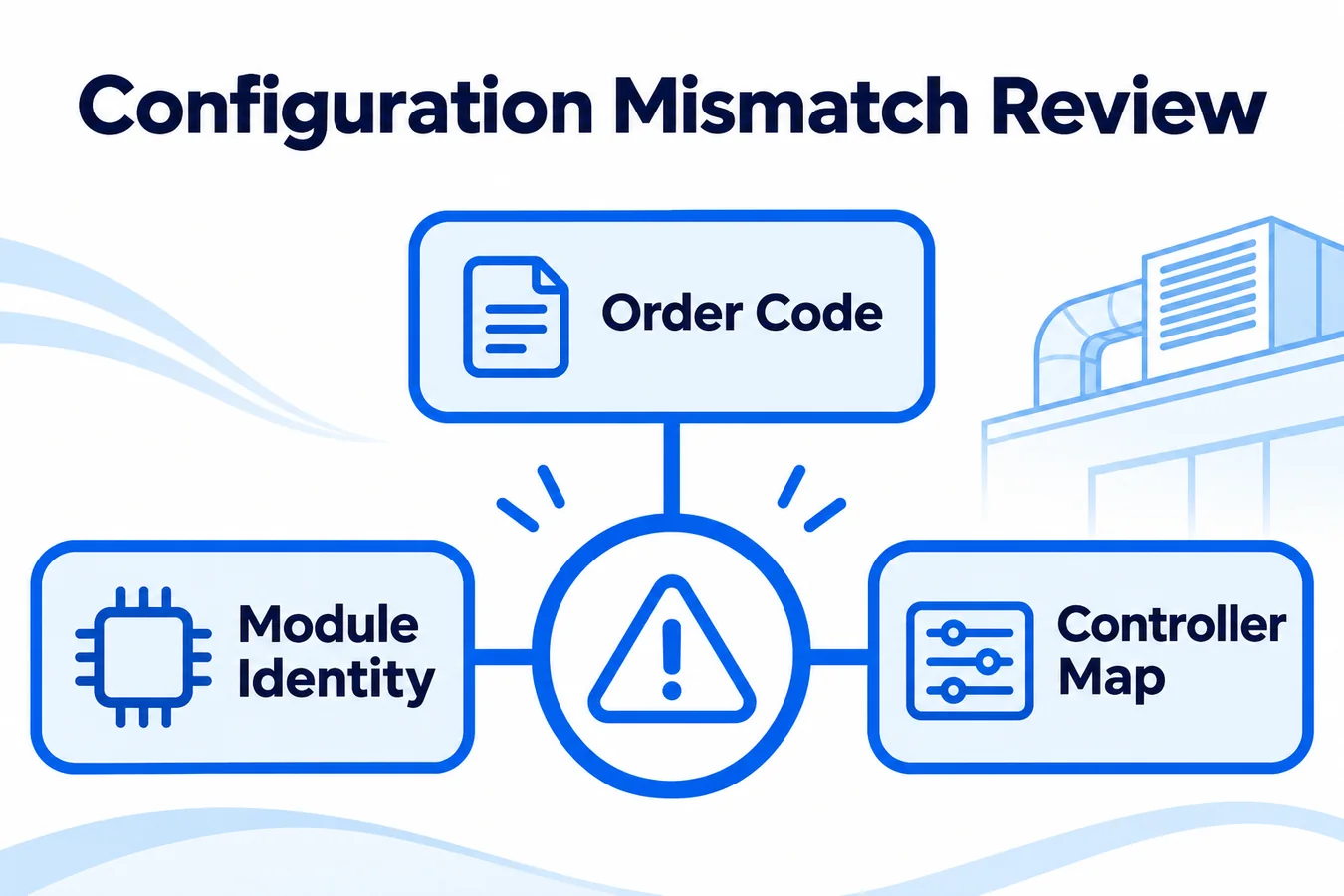
Finding one involves an incomplete module identity
Assume the schematic calls for a supplier series, purchasing orders a short description, and the lab report records a full assembly suffix. The review cannot establish whether the proposed production supply matches the tested module. The connector fits and communication works, but those observations leave the configuration relationship unresolved.
The correction starts by obtaining controlled supplier documentation for the exact assembly and identifying which characteristics the suffix and revision control. Engineering then updates the BOM, purchase description and receiving cross-reference. The specimen record is checked against those identifiers. If the installed lab specimen cannot be identified, the team resolves that uncertainty before relying on its result for production release.
Close the finding with the approved identifier relationship and evidence that the manufacturing process can preserve it. A sample receiving record and a unit serial record can demonstrate the traceability route. If electronic identity is available, document what it actually identifies and test the comparison used by the station. A readback that returns only the series name cannot resolve a suffix difference on its own.
Finding two confuses a detector test with installed coverage
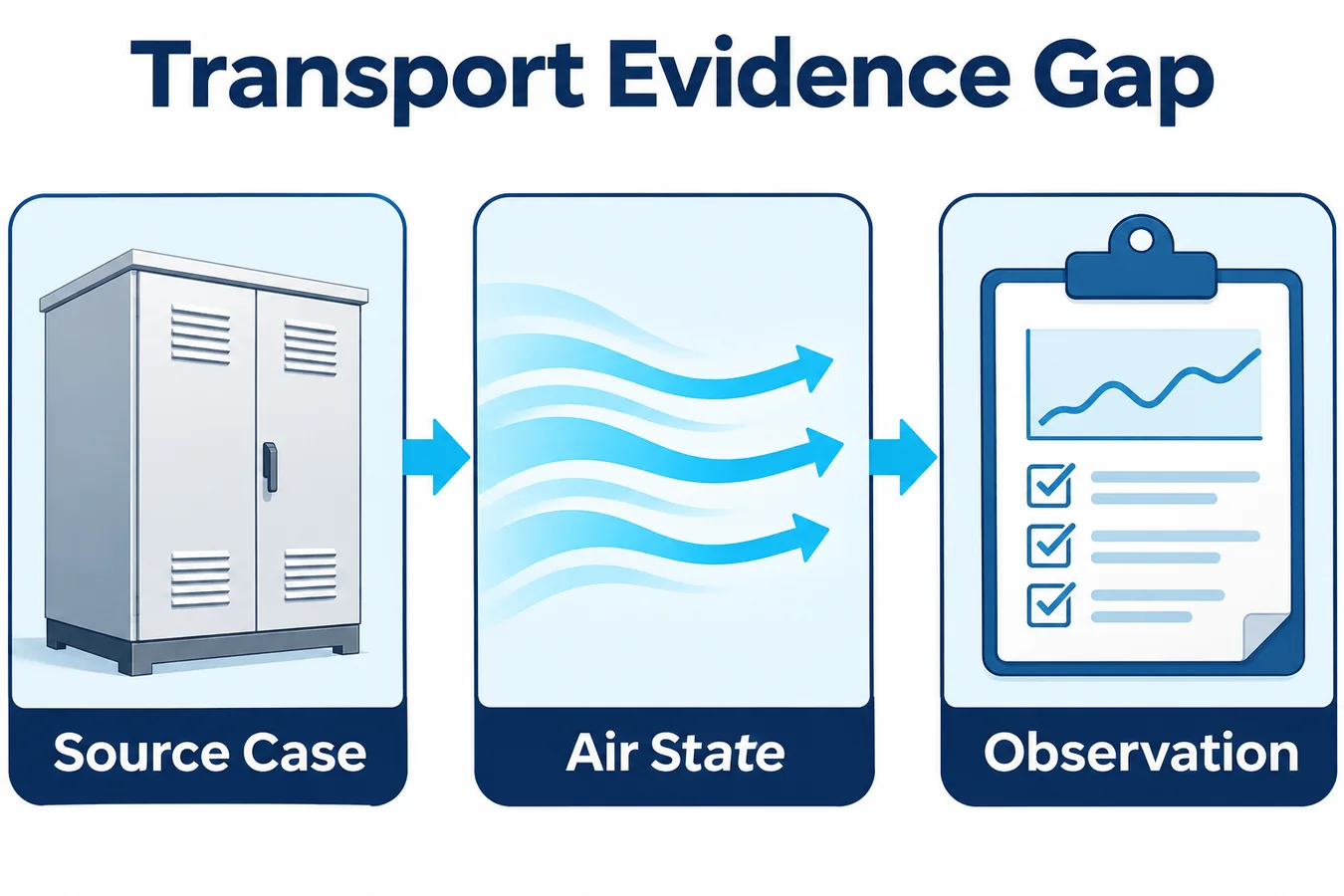
In this scenario, a module bench test passes and the project summary claims coverage for an equipment cabinet. The report describes the sensing element’s behavior under its test method. It does not establish how a release from relevant sources reaches the installed inlet with the production panels, bracket and air path present.
Identify the exact claim being made by the equipment design. Map source cases, applicable operating states and the installed sensing geometry. Compare that map with the available evidence. Use the gaps to define the additional tests and specimen configuration under the approved equipment evaluation plan. Retain the component report for the claims it supports and link the installed results separately.
A useful closure shows the source case and operating condition for each installed result. It also identifies temporary fixtures or openings that could change transport. If the test was conducted with a service panel removed, document the effect on applicability and obtain the required evidence for the production construction. The corrected summary should let a reader distinguish component behavior, gas transport and equipment response.
Finding three transfers coverage across an untested variant
Suppose a cabinet family gains another coil arrangement or discharge orientation. The mounting bracket remains in the same drawing position, so the change request proposes inheriting the previous transport report. The review finds that a new pan edge or panel seal changes a path represented in that report. The unchanged bracket alone does not establish the new relationship.
Compare the revised construction with the original specimen and release cases. Identify which sources and air states can be affected and which claims remain covered. The result may justify a focused retest rather than a repeat of unrelated electrical checks. Record that rationale with the affected model and serial range so the evidence transfer remains understandable after another revision.
Close the finding with the updated configuration matrix, accepted applicability assessment and any new results required by the evaluation. Update order rules and installation documentation if the variant has a different approved construction. Where the change is deferred, identify which product codes remain outside the released scope. This keeps a provisional engineering proposal from becoming an assumed production option.
Finding four treats a command as proof of the physical action
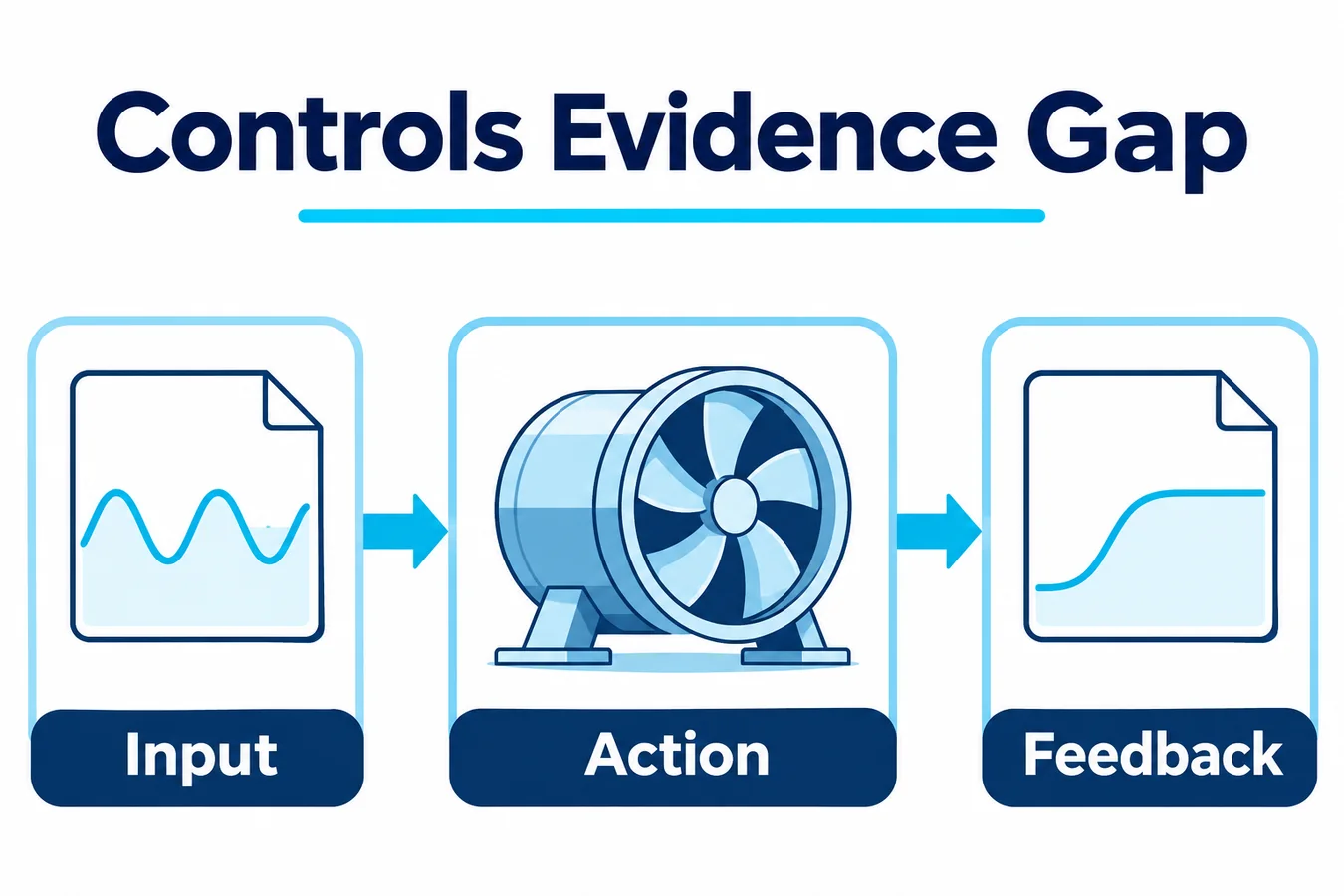
Assume the controller log records the expected mitigation command after an injected input. The test report marks the equipment response as verified, yet the test recorded neither a proving signal nor observation of the credited device. The log establishes that the command path reached the recorded point. The evidence for the physical response remains open.
Review the applicable equipment sequence and identify the observable state of each credited action. Define whether the verification uses an available feedback signal, direct observation or another method specified by the approved procedure. Include the normal demand state and relevant control priorities that could influence the device. Capture intermediate signals so a failed run can distinguish command generation from output delivery and device operation.
Close the finding by executing the prescribed check on the identified build and recording the actual result. If a feedback point is used, verify that its mapping corresponds to the intended device and state. An unrelated or stale feedback point can create a second evidence gap. Preserve the original command-only result in the history and link the complete verification that now supports the equipment claim.
Finding five collapses fault and alarm information
A draft controller interface might use a single status field for both a refrigerant event and detector availability. Reviewers find that a new diagnostic code overwrites an active alarm indication in the event record. The finding concerns the specific data handling and the effect on the equipment sequence, diagnostics and retained history.
Obtain the exact supplier protocol and document how the equipment represents simultaneous conditions. Trace the parser, internal state, output logic and service display using the reviewed software revision. Select challenge cases that exercise the ambiguity, including a diagnostic arriving while an event remains active and a recovery message arriving after a communication interruption.
Closure requires a defined interface contract and test evidence for the corrected handling. Capture enough of the input trace and controller result to show which condition remained active and which changed. Review the equipment actions against the approved sequence. If only the display changes, record that scope explicitly. If output handling changes as well, include its affected verification in the closure package.
Finding six leaves startup configuration implicit
In this case, a sensor and controller both initialize successfully when powered together. During service simulation, replacing or restarting one board produces a different sequence. The software assumes that the first received message contains a valid operating value, while the reviewed interface distinguishes initialization from valid data.
Describe the power and communication sequences the equipment supports. Identify when each component can report its identity, availability and operating state. Check whether controller configuration is preserved through the relevant restart paths and whether stale information survives in a way that affects the sequence. Use the actual interface definition to decide which transitions require verification.
Close the finding with a corrected startup interpretation and traces from the affected sequences. Record the unit build, controller software, module identity and initial conditions. A simultaneous power-up test remains part of the evidence, with the additional tests covering the paths that exposed the discrepancy. Update service instructions where a board replacement or programming operation creates a distinct supported recovery path.
Finding seven reviews the bracket without its tolerances
A drawing can specify a nominal inlet position while leaving the production bracket free to rotate or translate across a range. Assume the qualification specimen used a carefully aligned prototype. The review finds that an allowed assembly extreme could obstruct the inlet or move it relative to a collection feature. The finding concerns the gap between the tested construction and the construction the drawing permits.
Identify the dimensions and assembly features that control the relationship. Compare tolerance ranges, fastening method and nearby component clearances with the specimen record. If the design requires a revised stop, clip or bracket, show the controlled detail and evaluate its effect on the relevant installed evidence. Manufacturing should confirm that the final assembly method can achieve and inspect the intended condition.
A drawing update closes the documentation portion. The remaining closure evidence may include an as-built measurement, an assembly trial and affected tests on the revised configuration. Link those records to the drawing revision and production applicability. Where a service replacement can disturb the position, carry the relevant restoration detail into the service instruction.
Finding eight ignores the installed harness condition
Assume the bench prototype uses a short temporary cable, while production adds routing around an access panel and a field connector. The electrical test summary cites the prototype result for the final assembly. Reviewers also find that the harness clips shown in the model are missing from the released drawing.
Compare the actual production cable, connectors, routing and protection with the conditions represented in the electrical and environmental evidence. Identify the specific changes requiring evaluation under the equipment plan. Review service access as part of the assembly trial, including whether the approved disconnection and reconnection procedure restores the route and connector condition.
Close with a controlled harness drawing, applicable supplier documentation and evidence for the affected integration claims. An assembly photo can establish the evaluated route when linked to a drawing and specimen. It should have enough context to identify panel interfaces and clip positions. Include the final route in production and service instructions where it is necessary to preserve the evaluated construction.
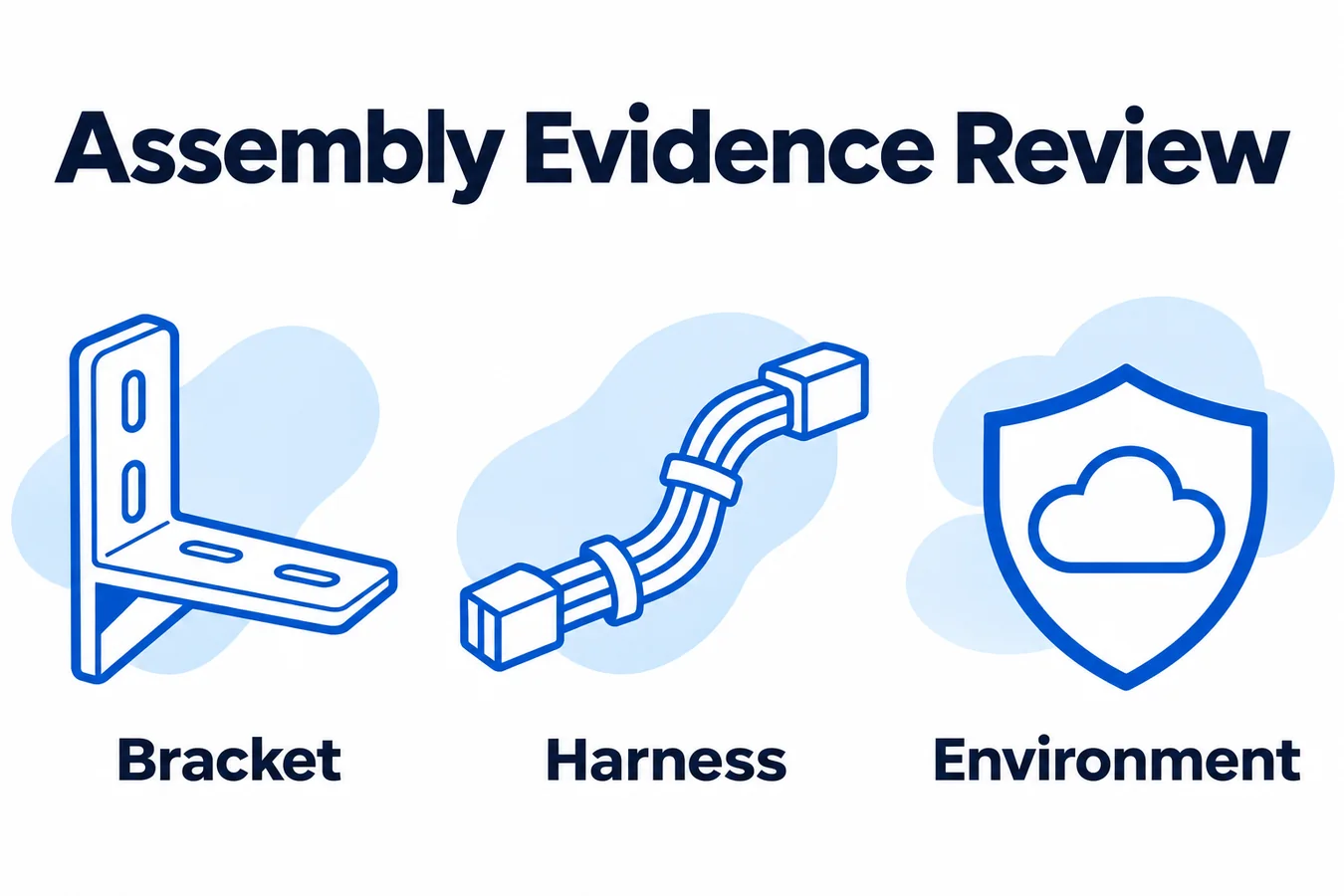
Finding nine extends environmental claims beyond their conditions
An example review package describes the sensor module as suitable for the unit’s enclosure environment but omits the local exposure around its mounting. The module data sheet and component test report may state conditions that differ from condensation, wash water, dirt or temperature cycling at the installed assembly. The missing relationship should be investigated using measured or otherwise justified equipment conditions.
Document the relevant environment at the proposed installation within the appliance. Include the bracket, inlet protection, connector and harness as they will be supplied. Compare the evidence with the sequence of exposures the equipment evaluation requires. If a cover or shield is added, determine whether it affects gas access and whether installed response evidence must be revisited.
Closure should identify the exposure, specimen construction, test method and result for the affected claim. A supplier statement about the module can remain supporting evidence, with its conditions visible. A revised assembly can be released when the necessary review and qualification establish applicability to that construction. Preserve the relationship so a later material or cover change triggers the appropriate assessment.
Use a corrective-evidence matrix at the review meeting
The matrix below turns observations into assigned decisions. It assumes an equipment development program with separate mechanical, controls, supplier and production owners. Actual ownership and acceptance follow the OEM program.
| Illustrative finding | Evidence currently available | Corrective evidence requested | Closure owner |
|---|---|---|---|
| Module suffix missing from production BOM | Lab specimen identifier and series-level purchase description | Controlled part relationship, revised BOM and receiving check | Product engineering with supplier quality |
| Cabinet coverage claimed from bench test | Component response report | Source-case map and required installed test results | Qualification lead |
| New orientation inherits old report | Nominal bracket drawing | Applicability assessment and affected tests | Mechanical engineering |
| Command logged without device observation | Controller event trace | Prescribed equipment action verification | Controls and test leads |
| Diagnostic overwrites retained event | Parser output and fault log | Revised contract, challenge trace and affected sequence result | Software owner |
| Production harness differs from specimen | Prototype cable record | Final drawing and affected electrical or assembly evidence | Electrical and manufacturing leads |
| Replacement applicability unresolved | Similar connector and supplier proposal | Approved supersession and serial-based service instruction | Service engineering |
Give every row a configuration reference, target disposition and due owner. Review whether the requested evidence actually closes the observed discrepancy. A drawing correction can resolve a part identity issue while leaving its production detection process open. Split those deliverables in the same finding if different teams own them.
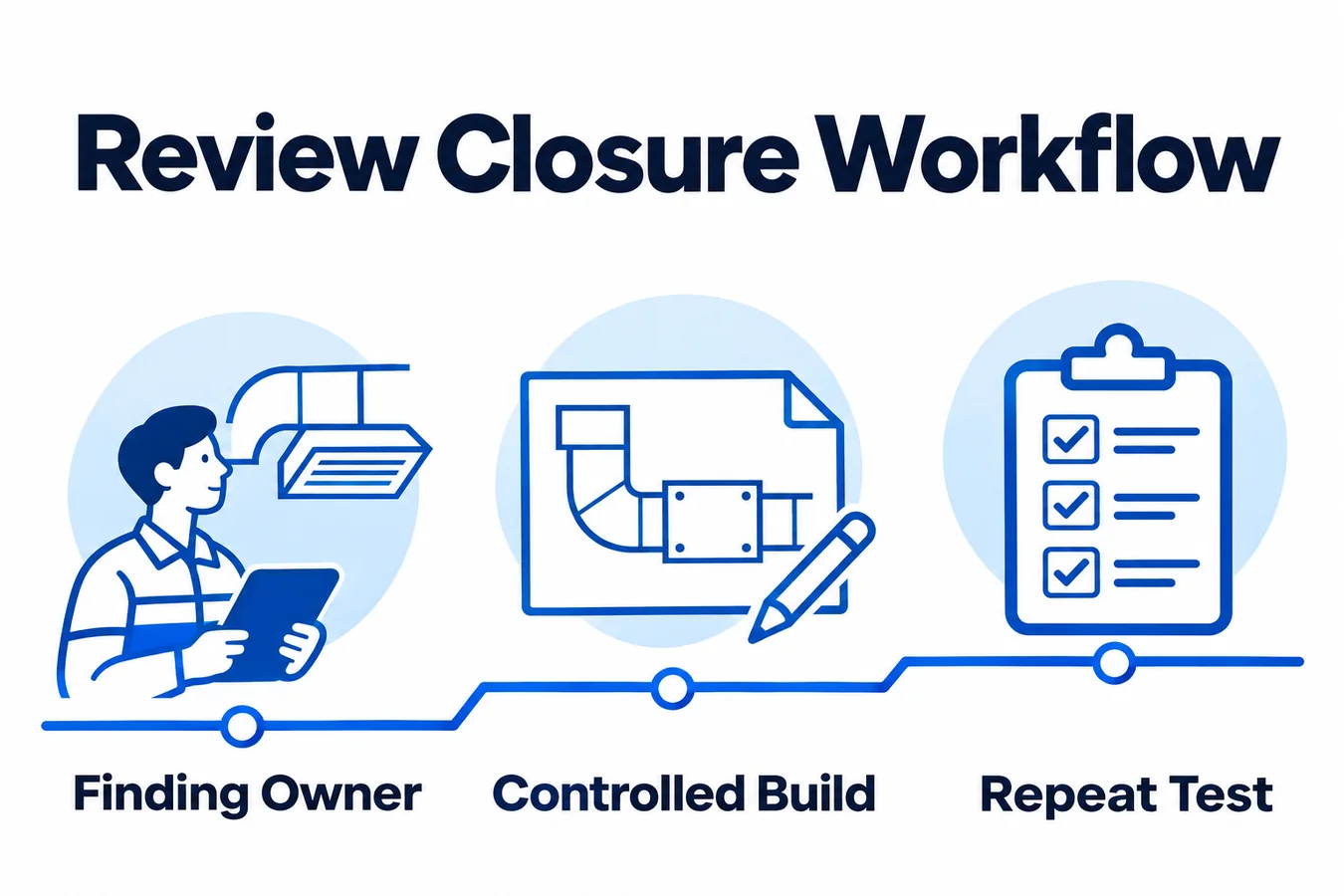
Close findings on a controlled build
A corrective change often affects more than the component named in the finding. Moving a bracket can alter the harness, adding an inlet cover can affect transport, and changing software can alter logs or output behavior. Identify those dependencies before scheduling the retest. The closure package should name the final combined construction used for the result.
Record the specimen before and after correction. If several changes are made at once, explain which findings each change addresses and what evidence supports the combined build. Keep the test report and released drawings aligned. A passing result from a hand-modified bracket needs a controlled drawing and an applicability review before the team can use it as evidence for repeatable manufacture.
Ask a reviewer who did not make the change to trace the finding through the correction and result. They should be able to identify the original discrepancy, the affected configuration, what changed and why the result supports closure. This is also an opportunity to catch a report that names the previous firmware or a photo that shows the prototype harness.
Review replacement applicability before design release
Assume the prototype program uses one module revision and the service plan lists a later supplier revision as a direct replacement. The connector is unchanged, but no record establishes compatibility with the controller installed in earlier serials. This is a design-release gap because the equipment support plan already depends on that relationship.
Obtain the supplier’s controlled change description and compare the interface, configuration identity, electrical conditions, mounting and diagnostics relevant to the equipment. Identify whether replacement requires another part or a controller update. Establish the applicable serial range and the prescribed verification after service. If evidence is incomplete, keep the service applicability decision open and provide a supported interim parts path.
Close the finding with the approved supersession record and a sample lookup from an actual equipment identity. Confirm that fulfillment can select the correct assembly and that a technician can recover the applicable instruction. Include any coordinated software step in the kit and service record. This connects the design review to the product configuration that will exist years after the launch team moves on.
Turn recurring findings into specific release checks
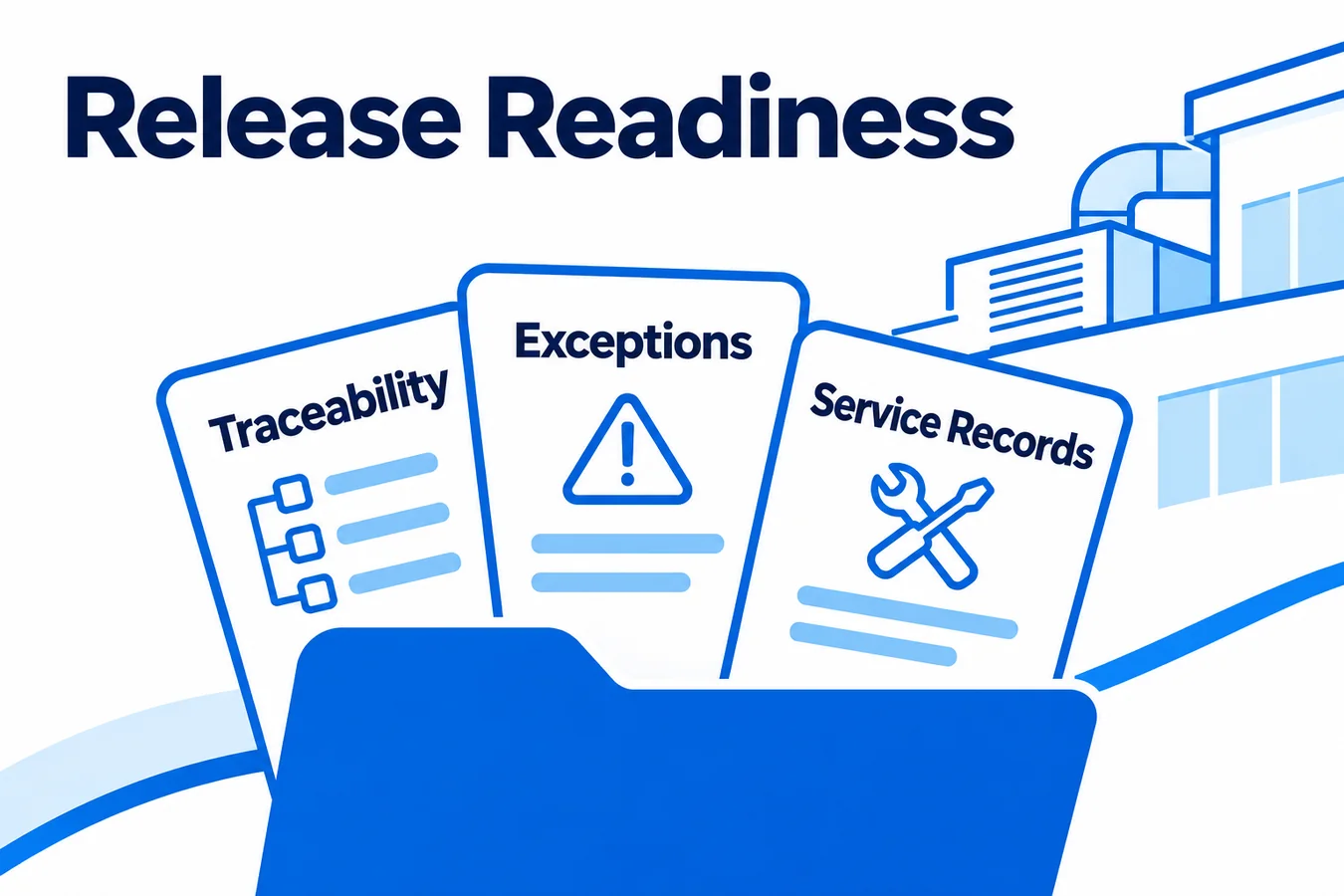
Review the closed findings for checks that can prevent the same discrepancy in the next design change. An omitted suffix can lead to a mandatory identifier field in the BOM template. A specimen mismatch can lead to a configuration snapshot before testing. A command-only report can lead to a required field identifying the observation used for each credited equipment action.
Keep those checks connected to actual failure opportunities. A generic checkbox stating that the RDS is complete offers little information about the construction or evidence. A release check asking whether each allowed order code resolves to an approved sensing assembly, controller configuration and evidence set is more reproducible. Assign the check to a role that can verify the relationship.
Review the effectiveness of the check on the next change request. If reviewers keep finding the same missing relationship, examine how the work is handed between teams. The source may be a truncated purchase description, an uncontrolled fixture recipe or a service system that cannot express a serial boundary. Correcting that interface can close the process gap across several product variants.
Preserve the failed run and the corrective reasoning
When a retest passes, retain the failed run with enough context to explain what the team learned. Record whether the failure was reproduced, which observation supported the cause and what the correction changed. If the investigation identifies a test setup error, document the setup correction and its effect on the original result. The next reviewer can then distinguish a design correction from a report correction or a repeated test.
For example, assume an action verification fails because a proving point was mapped to another channel. The revised mapping can be checked independently, then the affected sequence can be repeated on the corrected build. The closure record should identify both results. If the physical device had operated throughout, the investigation explains why the recorded evidence disagreed with observation. That detail can prevent unnecessary component replacement during a similar future review.
Track findings that share a cause across several units or reports. A copied test template might omit the same identity field in multiple reports, or a common programming recipe might affect several variants. Assign the shared correction once, then verify its applicability and closure for each affected configuration. This avoids closing one visible example while leaving the same unsupported claim elsewhere in the release package.
Evaluate the ZRT512C-A candidate with controlled documents
Winsen lists the ZRT512C-A as a refrigerant detection module. For an R454B equipment program, request the exact proposed configuration, supplier assembly identifier, interface definition, firmware identity, mechanical drawing and supporting evaluation documents. Map them to the unit build and to the specific claims in the design review. The candidate review should resolve applicability for the actual combination being developed. Winsen ZRT512C-A manufacturer profile

The local product listing can start the enquiry. Use the controlled documents supplied for the selected assembly when reviewing integration details and change proposals. Include the equipment model family, intended refrigerant configuration and unresolved interface questions in the request. ZRT512C-A ഉൽപ്പന്ന ലിസ്റ്റിംഗ്
പതിവായി ചോദിക്കുന്ന ചോദ്യങ്ങൾ
Which finding should the team investigate first?
Prioritize findings according to their effect on the equipment claim and the decisions they block. A missing specimen identity can undermine several test results at once. A clear definition of that configuration may need to precede retesting or an applicability assessment.
Does every drawing change require a complete retest?
Determine which claims the change affects and document the rationale. Some corrections resolve an identifier or record problem. Others alter transport, interfaces or equipment behavior and require affected tests. The applicable equipment evaluation and reviewer disposition determine the evidence needed.
Can simulation close a controls finding?
Simulation can support the functions it exercises under the documented method. Identify where the stimulus enters and which outputs or observations it includes. A finding about physical equipment operation needs the prescribed evidence for that operation as well.
How should an unresolved supplier question appear at release?
Record the question, affected combinations, owner and effect on release scope. Obtain a controlled answer or an approved disposition before using the unresolved assumption to support those combinations. Keep the record visible to purchasing and service if their decisions depend on it.
What makes a review finding ready to close?
The evidence should identify the corrected configuration, demonstrate the required relationship and resolve the original discrepancy. A second reviewer should be able to follow that chain through the released documents, test result and production or service applicability.
Request an OEM design-review package
Provide the unit configuration, proposed R454B sensing assembly, mounting and harness drawings, controller interface, software identities and existing test summaries. List the specific findings and the decisions each one prevents. Ask for the exact candidate documents and agree on the corrective evidence, specimen build and review owner for each open item. Contact the OEM integration team
