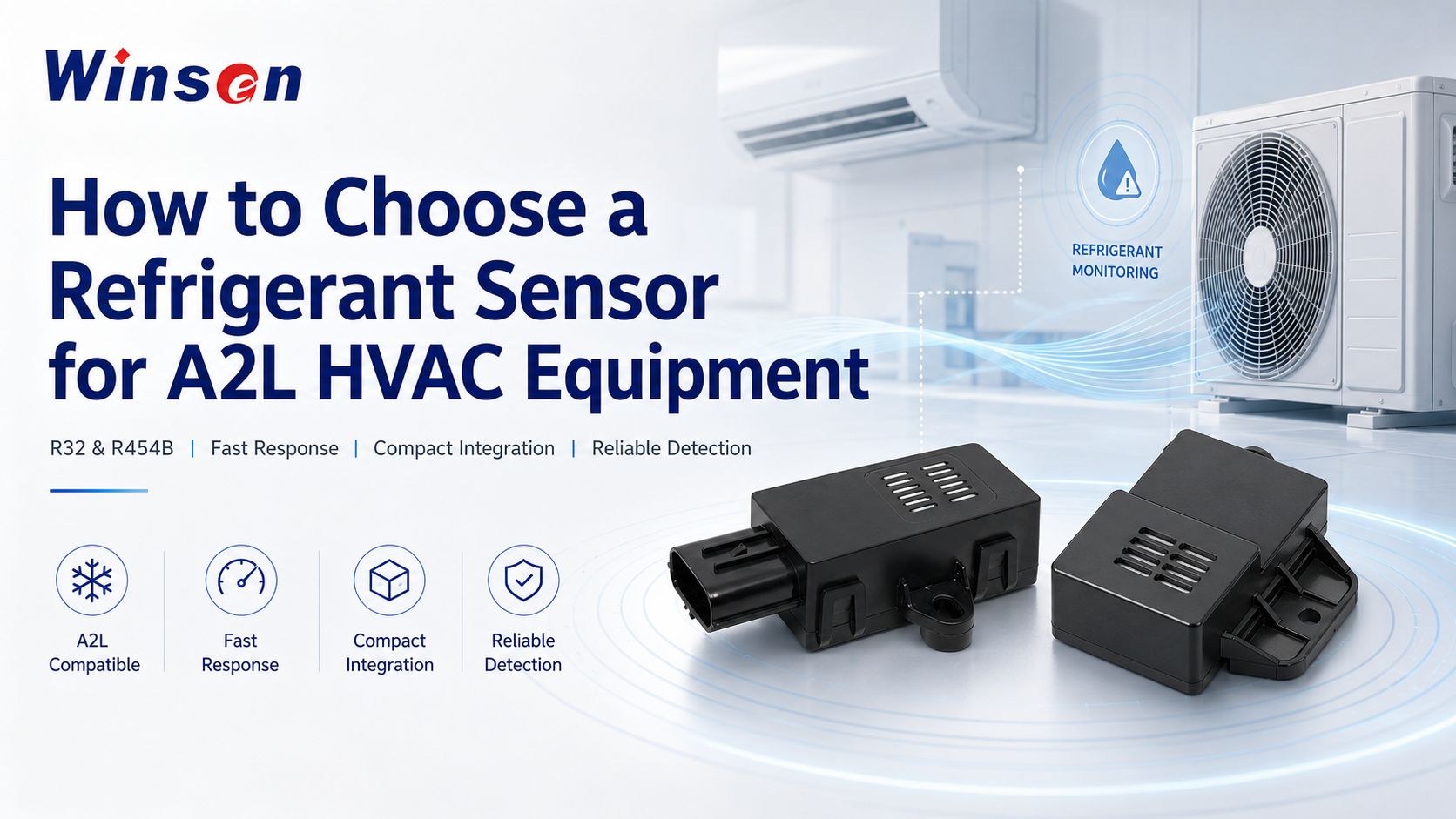
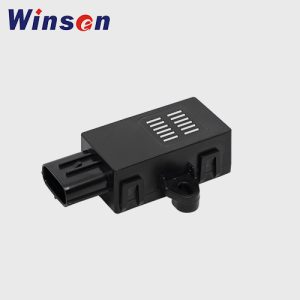
AC Refrigerant Sensor

AC Refrigerant Sensor (Leak Detector) — Split/VRF • Central AC • Heat Pump

Winsen® electronic AC leak sensors provide continuous, fixed monitoring for air-conditioning refrigerants across residential and commercial buildings. We support A1 (R134a, R410A, R404A), A2L (R32, R454B, R1234yf/ze) and A3 (R290, R600a) gases. Choose Yra n ppm išankstinio įspėjimo arba MOS/IR-LEL for %LEL safety interlocks—ready for BMS/PLC via 4–20 mAAr RS-485 Modbus, ir relės išėjimai.

Pick by Refrigerant Class & Measurement

A1 (R410A / R134a) — NDIR PPM

  • Typical ranges: 0–1,000 / 0–5,000 ppm
  • Outputs: 4–20 mA, RS-485 Modbus, 1–2 relays
  • T90 ≤ 30 s • Low drift, long life

A2L (R32 / R454B / R1234yf/ze) — NDIR PPM / %LEL

  • PPM early warning and/or 0–100% LFL/LEL
  • 4–20 mA / RS-485 / relays
  • VRF/VRV rooms & hotel guestrooms

A3 (R290 / R600a) — %LEL Safety

  • Range: 0–100% LEL (IR-LEL or MOS)
  • Relays for ventilation & shutdown interlocks
  • IP options for plant/mechanical rooms

What is an AC Refrigerant Sensor?

An AC refrigerant sensor is a fixed, electronic detector installed near AC equipment to measure refrigerant concentration and automatically trigger alarms ir interlocks (ventilation, unit shutdown). It complements handheld sniffers used by technicians for pinpoint leak search.

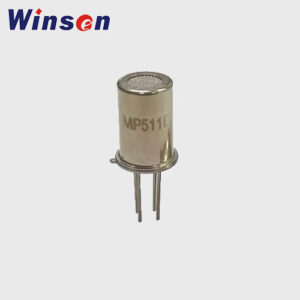
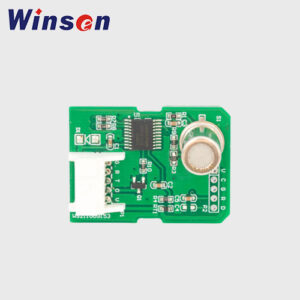
NDIR šaltnešio jutiklis

Puslaidininkinis šaltnešio jutiklis

Technology Options

TechnologijosGeriausiasDiapazonasPrivalumaiSvarstymai
NDIR (infraraudonųjų spindulių)A1 ppm; A2L ppm/%LELppm → %LELHigh selectivity & stability; not O₂-dependent; long lifeProtect optics from condensation/dust (filters/enclosures)
MOS (puslaidininkis)A2L/A3%LEL0–100% LELFast response; robust; cost-effectivePossible cross-sensitivities; periodic calibration advised
Katalizinis karoliukasGeneral hydrocarbons (A3)0–100% LELMature technologyReikia O₂; gali apsinuodyti silikonais/švinu

Tipinės programos

Split/VRF indoor units & hotel rooms

Mount low (~150–300 mm above floor) near indoor units and pooling points. Pre-alarm → fresh-air purge; main alarm → fan/indoor-unit shutdown.

Central AC (AHU/MAU) & mechanical rooms

Place near coils, TXVs, service valves, and floor low spots/sumps; use IP-rated housings and BMS interlocks.

Line sets & evaporator/condenser sections

Monitor around brazed joints, manifolds; avoid strong supply streams that could bypass the sensor.

Heat pumps

For A2L systems, use %LFL tiers (≈25% pre-alarm; ≈50% main) to trigger ventilation and safe shutdown.

Core Specifications

ParametrasVertė / parinktis
MatavimasNDIR ppm and/or %LFL (MOS/IR-LEL)
Išėjimai4–20 mA (2/3 laidų), RS-485 Modbus RTU, 1–2 relės (N.O./N.C.)
Atsakymo laikas (T90)≤ 20–30 s tipiškas
Supply12–24 VDC (kiti pagal pageidavimą)
Eksploatavimo sąlygos–20…+50 °C; 15–95 % santykinis oro drėgnumas nekondensuojantis (priklauso nuo modelio)
AptvaraiWall, panel, duct; housings up to IP65
AtitiktisCE & RoHS; designed for BMS/PLC integration

Placement & Setpoints — Good Practice

  • Montavimo aukštis: Most AC refrigerants are heavier than air ⇒ mount low; verify with site airflow.
  • Aprėptis: ~5–10 m radius per sensor in open rooms; add units near valves/joints and low pockets.
  • Alarms: A2L/A3: pre-alarm ≈25% LFL; main ≈50% LFL. A1: ppm bands (e.g., 1,000–5,000 ppm) per project spec.
  • Užraktai: Pre-alarm → ventilation; Main → equipment shutdown + beacons/horns/BMS event.

Užbaikite slenksčius ir kiekius pagal savo projekto specifikaciją ir vietinius kodus.

Kodėl pasauliniai klientai renkasi mus?

Bendrovė nuosekliai laikosi kokybės politikos „Puikus meistriškumas, mokslinės naujovės, tobulumo siekimas ir pridėtinės vertės paslauga“. Formuodamas gamybos procesų valdymo planus ir darbo instrukcijas sukūrė standartizuotą, atskaitingą ir reglamentuotą procesų valdymo sistemą. Be to, įmonė savarankiškai sukūrė MES gamybos valdymo sistemą, leidžiančią visapusiškai ir vizualiai valdyti visą darbo eigą.

30+ METŲ PATIRTIS

R&D, manufacture and sales of sensors and sensing solutions.

KOKYBĖS GARANTIJA NUOLATINIS TOBULINIMAS

Visiškas ir griežtas proceso srauto valdymas kartu su reikšmingais patobulinimais.

TARPTAUTINĖ RINKA

Pristatykite jutimo produktus į daugiau nei 100 šalių ir regionų.

STABILI TIEKIMO GRANDINĖ PATIKIMA GAMYBA

Pagrindiniai komponentai, kuriems netaikomi apribojimai, pažangi gamybos ir bandymo įranga.

R&D STRENGTH TECHNOLOGY INNOVATION

200+ patents, 180+ R&D team members, self-built labs for continous innovation.

VIENO PASLAUGOS PASLAUGA

Profesionali konsultacija, greitas pristatymas, 24 valandų pagalba po pardavimo.

Leading the Industry, Innovative & Controllable Technology

With robust R&D capabilities, we maintain sustained input in R&D and unwavering commitment to technological innovation. This not only ensures that we remain at the forefront of industry but also drives continuous innovation, leading the future trend of the sensing industry.

10% R&D Input

The average annual R&D input exceeds 10% of the annual revenue.

5+ R&D Layout

With Zhengzhou headquarters as the core, a nationwide R&D and innovation system is being established, encompassing cities of Shanghai, Wuhan, Shenzhen, and Taiyuan.

180+ R&D Team

There are over 180 R&D personnel, including more than 10 with doctoral degrees and over 50 with master's degrees, who have an average of more than 8 years of experience in sensor development.

Daugiau nei 20 eksperimentų tipų

Su dujomis susiję, klimato aplinka, EMC, elektros našumas, mechaninis veikimas ir kt.

10 ir daugiau pažangių laboratorijų

CNAS laboratorija, MEMS laboratorija, UL laboratorija, nanokompozitinių medžiagų laboratorija ir kt.

400+ sets Leading R&D Equipment

Kubų saugykla, Die Bonder, litografijos mašina, dengimo mašina, SMT išdėstymo mašina, automatinė zondo stotis ir kt.

Prašyti konsultacijos

    Sėkmė! Jūsų pranešimas mums atsiųstas.
    Klaida! Buvo klaida, siunčianti jūsų pranešimą.

    Wechat

    „WhatsApp“

    FAQs — Freon Gas Sensors

    How many sensors are needed in a guestroom or office?

    Plan ~5–10 m radius coverage per sensor in open rooms. Add units near indoor units, valves, joints, and floor-level pockets where gas can accumulate. Irregular layouts typically need more sensors.

    Should I choose ppm or %LEL measurement?

    Use ppm (NDIR) for early warning and comfort/process monitoring; use %LEL (MOS or IR-LEL) to drive safety interlocks for A2L/A3 systems. Many projects deploy both.

    Where exactly should sensors be mounted?

    Most AC refrigerants are denser than air; mount low (≈150–300 mm AFF) near likely leak sources and pooling points. Avoid strong supply air. Duct/return versions can monitor airflow.

    How often do I need calibration and bump tests?

    Typical calibration is every 12–24 months with periodic bump tests (quarterly/biannual). Dusty/humid or aerosol-rich sites may need more frequent checks and filter maintenance.

    What causes false alarms or cross-sensitivity?

    Solvents/aerosols (silicone sprays, alcohol cleaners, paints) can affect semiconductor elements; heavy condensation/dust can obstruct optics. Use IP-rated housings, splash/dust guards, and good placement.

    Can Winsen customize for OEM/volume rollouts?

    Yes—ranges, firmware/Modbus mapping, connectors/harnesses, housings (IP), labels/branding, and packaging are customizable for volume deployments.

    Daugiau žinių apie šaltnešio jutiklius

    Nežinote Kuris jutiklis Ar teisinga?

    Gaukite nemokamą pradinę konsultaciją dabar

    buvo įtrauktas į jūsų krepšį.
    Kasa