
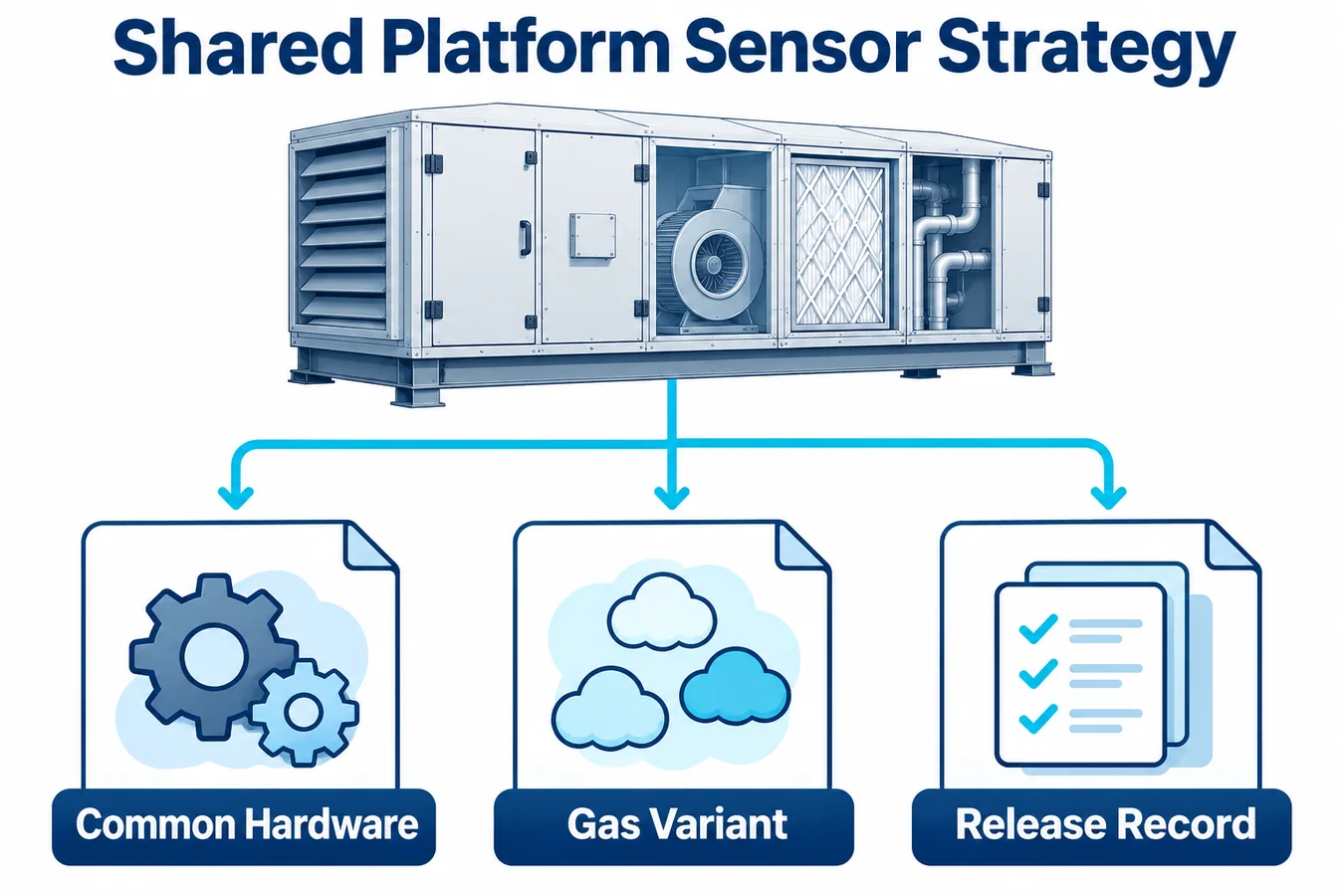
A shared HVAC platform can reuse a cabinet concept, controller architecture and manufacturing process across R32 and R454B equipment. The release decision still needs a precise definition of each supported combination. An R32 R454B sensor shared platform strategy succeeds when engineering can tell production which assembly to fit, software which configuration to load, certification reviewers which evidence applies, and service which replacement restores the approved build.
The practical unit of control is the complete configuration. Define the refrigerant variant, sensing assembly, mounting and harness, controller hardware, firmware, configuration data and applicable equipment documentation together. A common connector or a family name on a supplier page provides a starting point for integration. The product record must establish which combinations the OEM has actually evaluated and released.
UL Solutions describes an integral refrigerant detection system as stationary sensing coupled to automatic mitigating actions and explains its evaluation within the equipment certification where required. That equipment boundary is the basis for deciding how evidence can be shared across a product line. UL Solutions guidance on integral RDS inspection
Define the commercial promise and its configuration boundary
Begin with the products the platform is expected to support. Record refrigerant designation, equipment type, installation orientations, target markets and service life assumptions used by the business. Add whether the goal is one purchasing family, one production station, one controller board or one stocked service assembly. These goals have different engineering consequences. Sharing the purchasing family can coexist with separate configured parts and separate service lookups.
Translate each commercial goal into a verifiable statement. For example, the factory might use one test fixture with two controlled recipes, while service retains separate part numbers for the refrigerant variants. Alternatively, one assembly might support both variants under documented supplier conditions, with the equipment configuration locked through another identified mechanism. The OEM needs evidence for the actual implementation and an explicit way to recognize its state.
Keep the scope tied to buildable order codes. If the launch includes only one cabinet orientation in each refrigerant, place later orientations in a development list until their evidence is approved. A marketing platform name can cover several generations. The engineering configuration boundary must identify the generation and revision actually covered by the release.
Separate shared interfaces from refrigerant-specific meaning
A controller can reuse a physical interface while interpreting messages through a variant-specific contract. Document the meaning of measured values, alarm indications, diagnostic states, initialization status and identity fields in that contract. Identify which fields come directly from the module and which the equipment software derives. Where a value has units or a refrigerant reference, carry that meaning through logging and service displays.
Ask the supplier how the exact candidate assembly identifies its supported refrigerant configuration and how an OEM verifies it. The answer may be a controlled part suffix, an assembly label, an electronic identity or another documented method. Record limitations as well as capabilities. An unreadable or incomplete identity should have an explicitly reviewed treatment in the equipment configuration process.
UL’s discussion of updated RDS requirements includes factory presetting and calibration for the refrigerant used. Obtain the applicable requirements and supplier documentation for the intended evaluation scope before assigning any configuration operation to an OEM station or service tool. UL Solutions discussion of updated RDS requirements
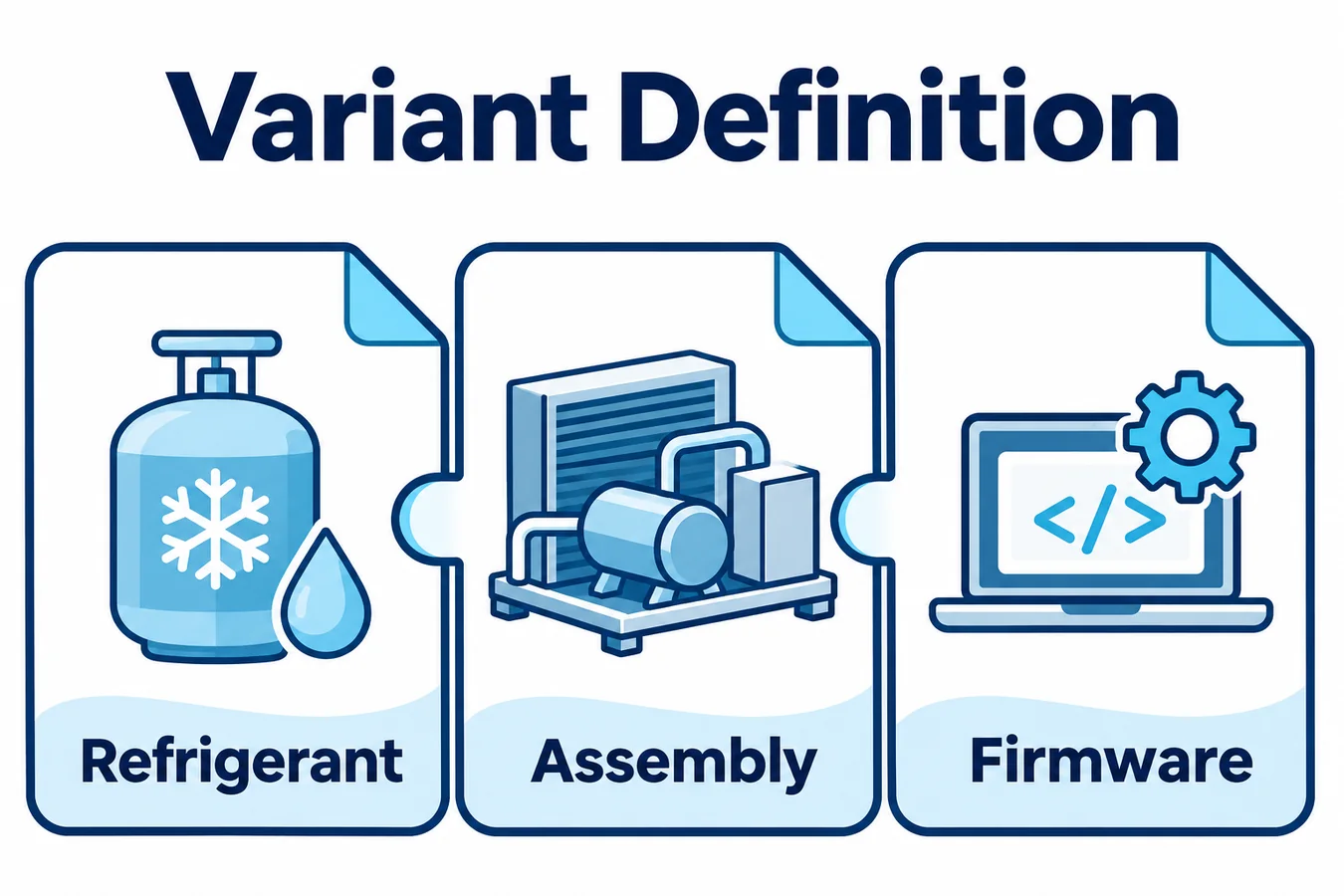
Choose the part-number structure deliberately
Compare a common supplied assembly, separate supplied refrigerant variants and a shared mechanical family with separate electronic configurations. Evaluate each against recognition at receiving, assembly error detection, software compatibility, service replacement and change notification. Procurement savings can disappear if a common description forces a technician to resolve an undocumented configuration on every replacement.
For separate variants, make the difference visible in the OEM bill of materials and the supplier purchase description. Include the complete suffix and revision applicability, with controlled drawings where necessary. A supplier’s abbreviated invoice description should resolve to the same item that appears on the purchase order. If the purchasing system truncates the distinctive part of the identifier, add a controlled cross-reference rather than relying on operator memory.
For a common assembly, define exactly what is common and retain the evidence that supports its use in both refrigerant variants. Establish how the controller determines the equipment configuration and confirms compatibility. Commonality should remain understandable after supplier firmware changes, an alternate harness is introduced or an older service unit returns to the factory. Design the identifier system for those later cases during platform development.
Make the BOM and software describe the same product
An equipment BOM can correctly specify the sensor while a programming station loads an older controller configuration. Conversely, software can be current while purchasing supplies a previous module revision. Manage these as combination errors. Link the order code to the hardware BOM, software release and configuration data through one approved configuration record.
Treat software code and configuration data as distinct controlled artifacts where the platform architecture separates them. A common executable may use a refrigerant-specific data package. Record both identities and the approved relationship. Include the station recipe or programming method used to establish that relationship, plus any verification available after programming. A record of the intended download is weaker than evidence of the state actually read from the unit.
Where identity cannot be read electronically, specify an alternative traceability route and its limits. For example, an assembly scan can connect a controlled module identifier with a unit serial record, while the controller reports its own software identity. The release review can then assess the combined coverage of those checks. Make rework follow the same relationship so a board replacement cannot leave the serial record describing its previous configuration.
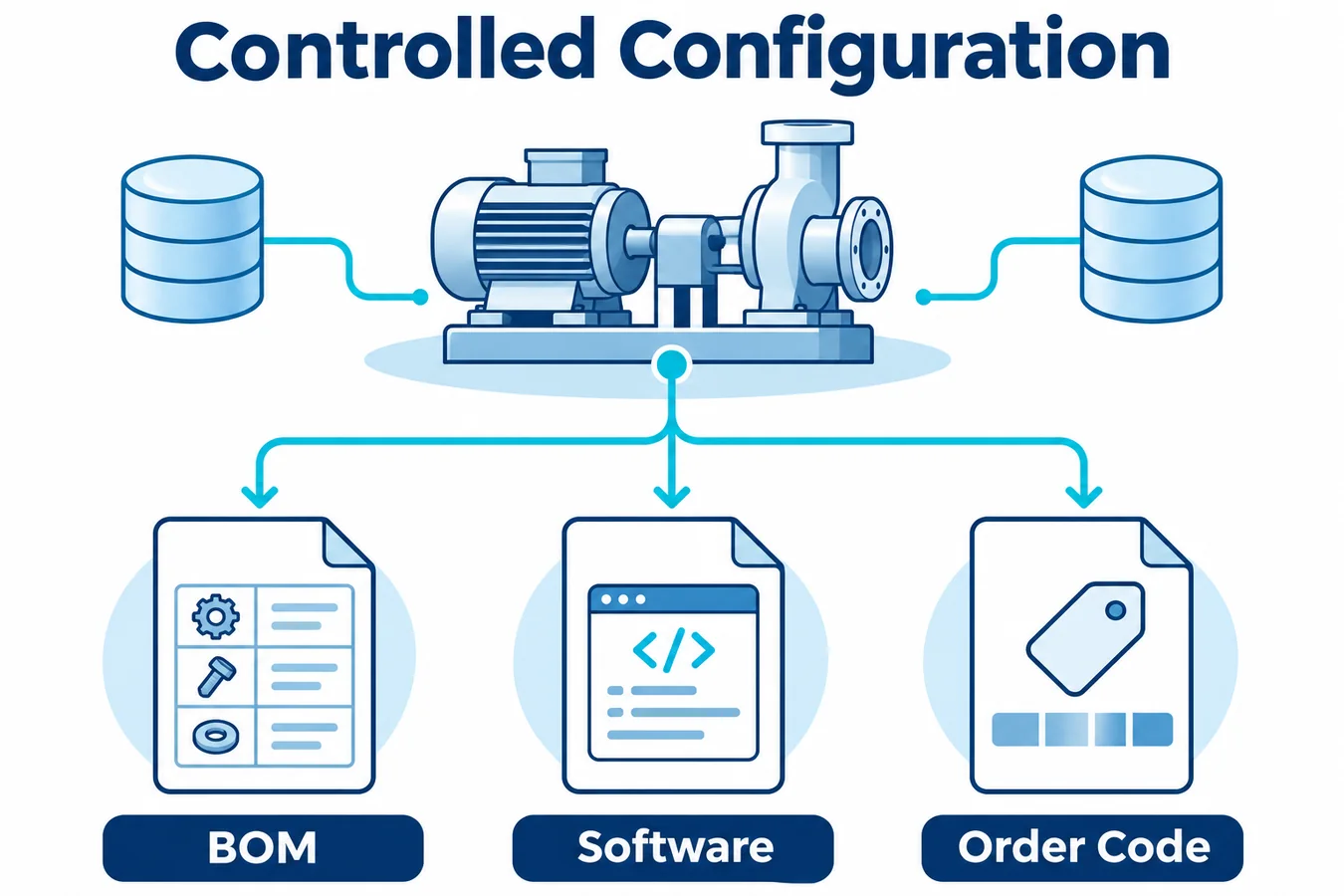
Build a compatibility ledger with explicit decisions
Use a ledger that describes combinations rather than a list of individually approved parts. Include the unit family and revision, refrigerant, sensing assembly, controller hardware and firmware, harness, applicable installation drawing and evidence reference. Assign an approval state with a reason. A row under review must remain distinguishable from a released combination in purchasing and manufacturing systems.
The following example assumes two refrigerant variants, a common controller board and two module assembly identifiers. Names are illustrative. No row represents an approved commercial product.
| Proposed combination | Existing evidence | Open question | Illustrative disposition |
|---|---|---|---|
| R32 unit, Assembly R, controller release P | Baseline hardware and installed tests | Confirm all production identifiers match specimens | Release after record review |
| R454B unit, Assembly B, controller release P | Shared electrical tests | Refrigerant-specific behavior and installed evidence | Hold pending variant evaluation |
| R454B unit, Assembly B, controller release Q | Approved variant baseline and software change report | Effect of revised diagnostics on equipment actions | Review affected sequence tests |
| R32 unit, Assembly B, controller release Q | Matching mechanical interface | Supplier applicability and configuration compatibility | Exclude from allowed combinations |
| Earlier R32 serial with replacement Assembly R2 | Supplier supersession proposal | Backward compatibility with installed controller | Service applicability review |
Make the ledger actionable. Manufacturing should be able to resolve an order code to an allowed row without interpreting engineering notes. Service needs a lookup from an actual serial to the supported replacement combination. A row that depends on a future test remains provisional even when the hardware is already physically interchangeable.
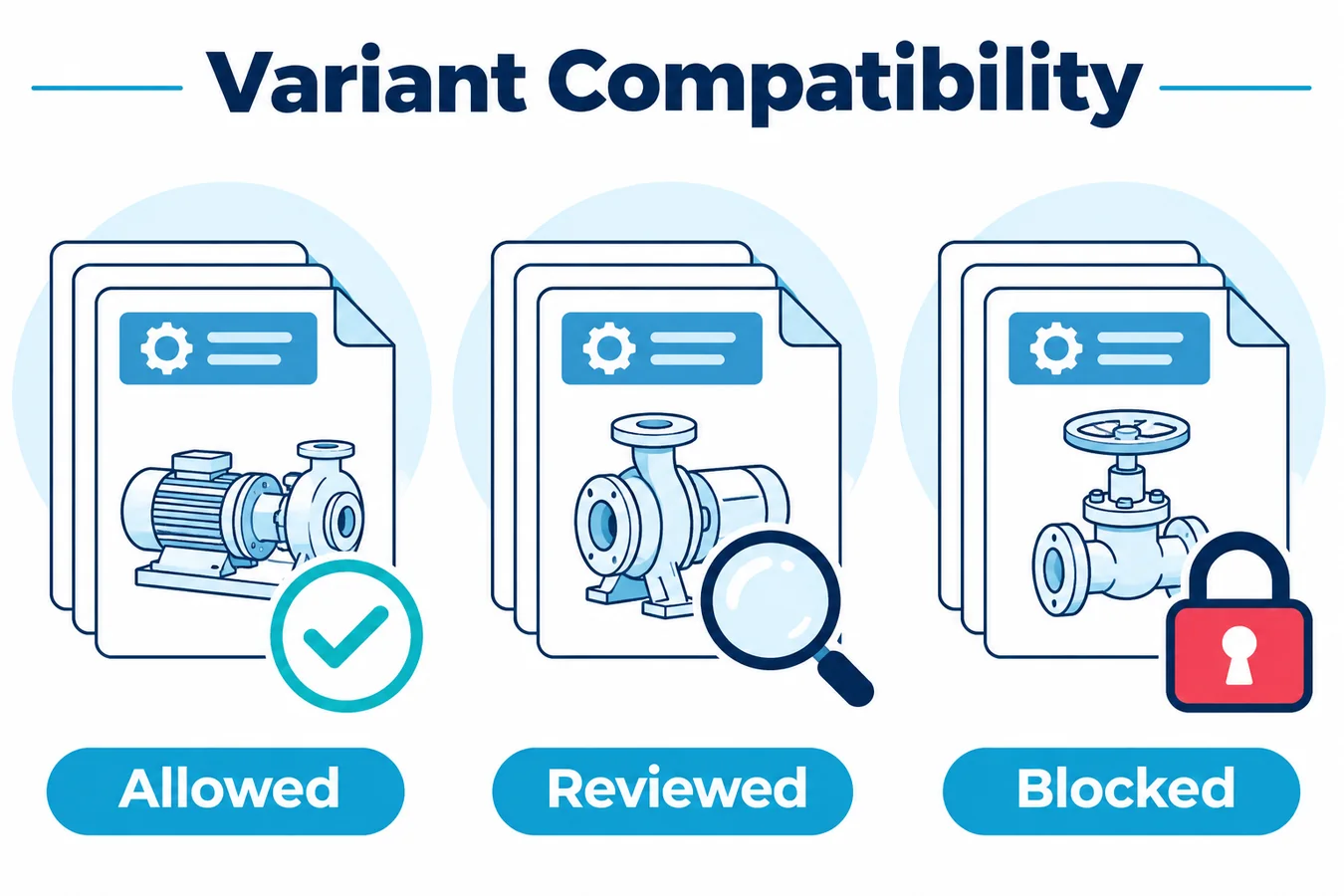
Reuse evidence by the question it answers
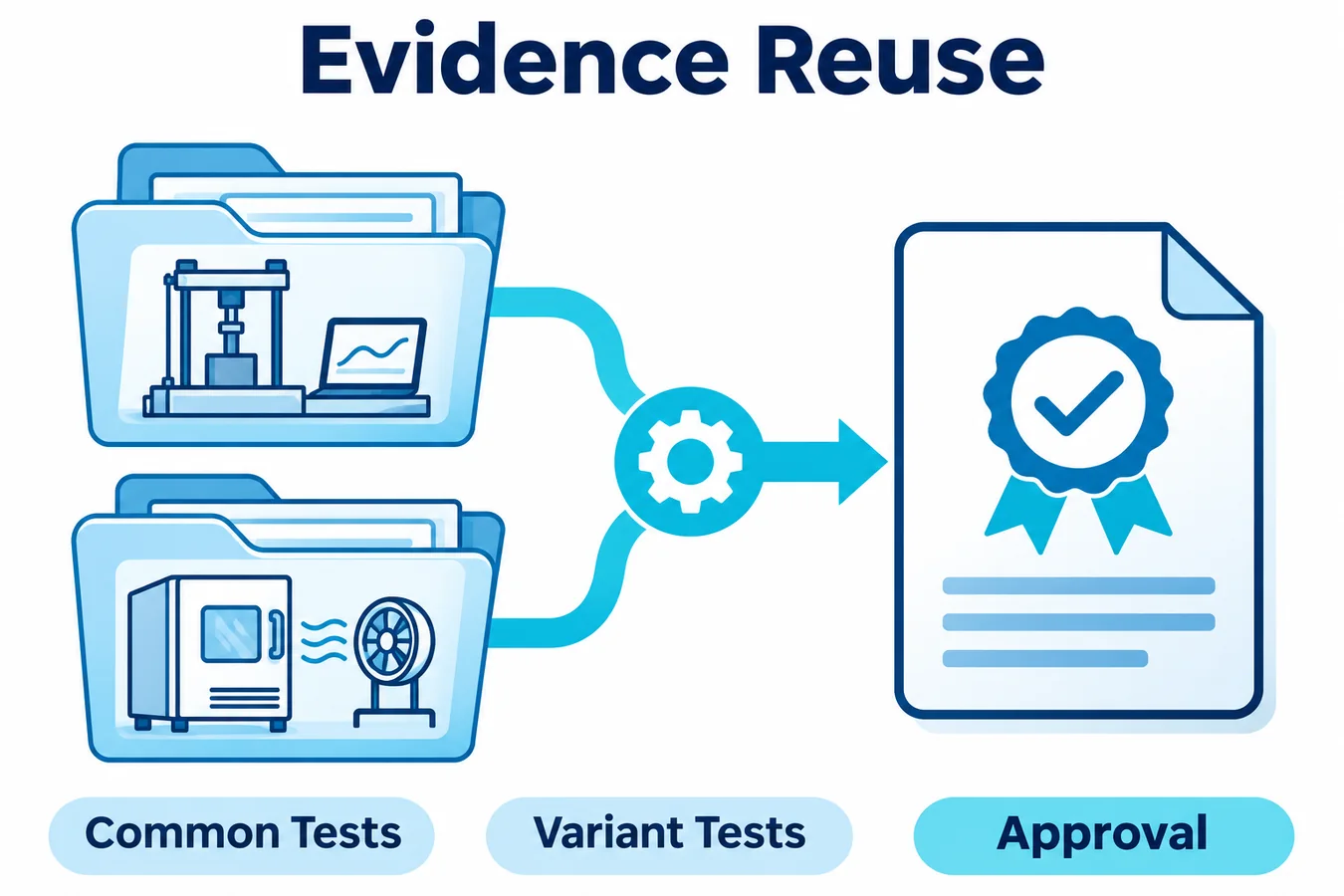
Electrical evidence can sometimes transfer across refrigerant variants when the relevant assembly, power demand, interface and equipment conditions remain covered. A software communication test can transfer only to the code and protocol relationships it actually exercised. Mechanical fit evidence covers the dimensions and tolerances represented by the specimens. Gas response and installed transport evidence require their own applicability argument.
Create an evidence map with one claim per row. State the claim, original specimen configuration, test method, result and proposed destination variants. Then explain what remains equivalent and what changes. This makes the reuse decision inspectable. A report title containing the platform name provides little detail about whether a later harness or sensor revision falls within its conditions.
Include certification review in the evidence plan at the stage appropriate to the equipment program. The applicable standard edition, market and evaluated construction affect what the team must submit. Record the reviewer disposition for a proposed inheritance decision and link it to the configuration ledger. If the reviewer requires a new specimen, identify its actual build and preserve its relationship to production.
Treat the specimen BOM as part of the test result
Before testing, freeze a specimen record with the installed sensing assembly, software identities, harness and mounting revision. Capture deviations from intended production construction. A hand-built prototype can have a correct module and controller yet use a temporary seal or wire route that changes the evidence. Describe those differences and determine which must be closed before production applicability is claimed.
After a test, update the record for any change made during troubleshooting. If the team replaces a controller between runs, the second run belongs to a new specimen configuration even when the cabinet serial remains the same. Preserve the previous state and record why the change occurred. This prevents a later summary from combining passing observations obtained from incompatible builds.
Use a concise configuration snapshot at the beginning of each report and a change log for subsequent runs. Include the source of each identity, such as a scanned assembly label or software readback. If a field was assumed because a tool could not read it, mark that uncertainty and resolve it before using the result to release a configuration that depends on it.
Challenge the strategy with an illustrative variant change
Assume a manufacturer launches an R32 platform and later adds an R454B variant using the same controller board. The refrigerant circuit and associated equipment documentation differ. Procurement proposes a common module family while software proposes retaining a common executable with variant-specific configuration data. The example assumes that the supplier can supply documented configurations under that family and that equipment evaluation remains incomplete for the new variant.
The team first separates the shared interface claim from the new installed-system claim. It references unchanged interface tests where their conditions remain covered and schedules the new variant-specific tests. Purchasing creates distinct orderable descriptions that resolve the exact supplier configuration. Production reads the equipment order code, loads the released data package and verifies the available identities against the allowed combination record.
During pilot assembly, one reworked unit receives a replacement board with the baseline R32 data package. The hardware checks pass because the connector and board are shared. A final combination check detects the disagreement between the unit order code and controller readback. The corrective action updates the rework instruction and verifies the repaired unit. The incident also becomes a deliberate challenge case for the production verification recipe.
Design production checks around plausible wrong combinations
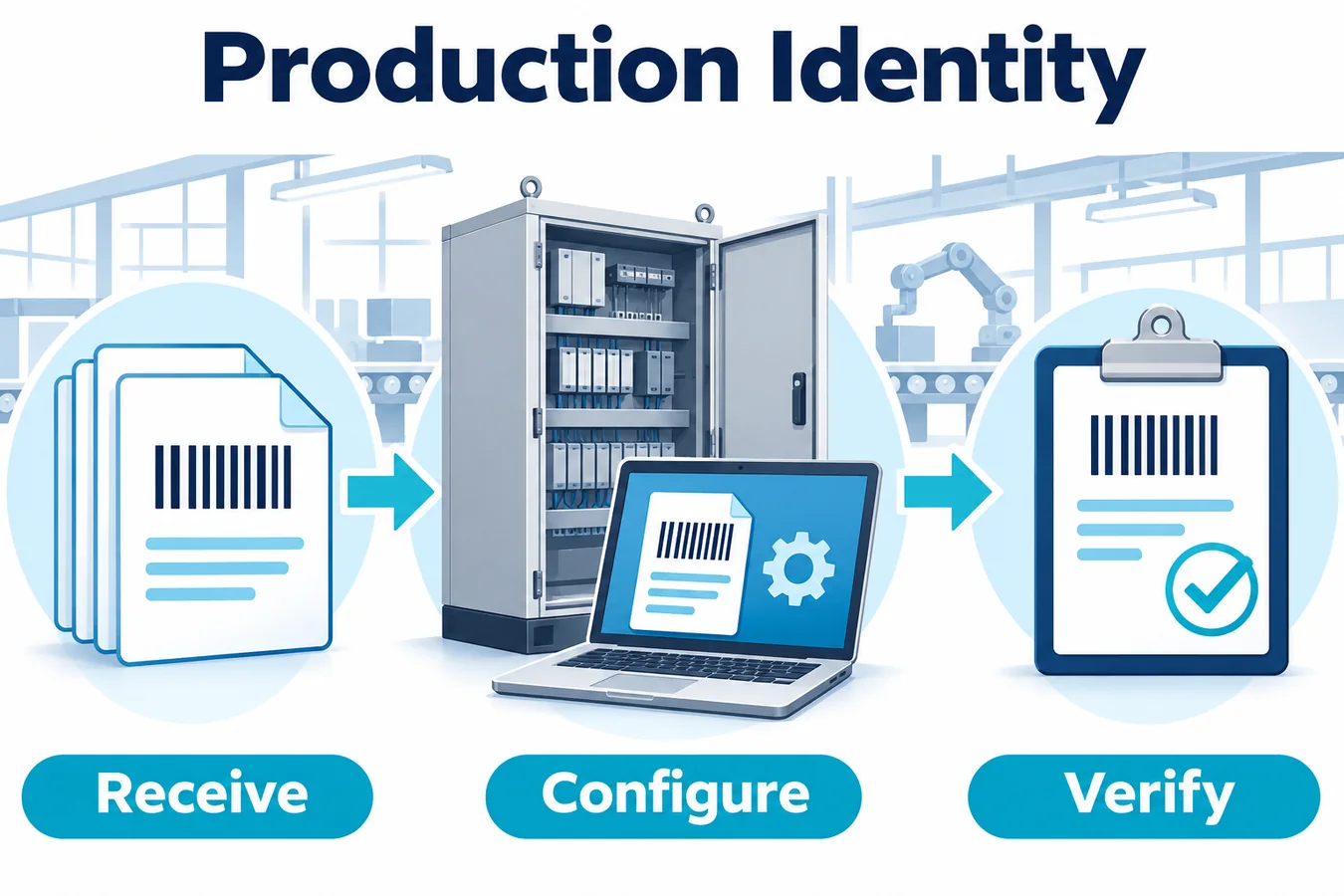
List the wrong combinations that the line could physically build. Include a correct family with a wrong suffix, a current board with an older data package, a harness with the same mating connector and a module installed after the serial scan was completed. Review which station can detect each case and what evidence it produces. A physical key can reduce certain errors while leaving software configuration errors possible.
Challenge the station with controlled examples of the errors it is supposed to catch. Record whether it identifies the mismatch and how the unit is routed for correction. Test the rework path as well as normal flow. If an operator rescans a part after a failed check, determine which identity remains in the serial record and whether the earlier failed result is retained for review.
Separate the manufacturing checks by purpose in the release package. Identity verification establishes a configuration relationship. Electrical connection checks exercise the installed communication or circuit path defined by the procedure. Functional checks establish specified controller and equipment behavior within their scope. Keep each result visible so a station dashboard cannot turn several partial checks into an unsupported complete-system claim.
Coordinate firmware updates across the installed population
A controller update can affect an installed sensor interface even when the module remains unchanged. Define which unit serials, sensor revisions and configuration packages the update supports. Include transitions from the software states actually present in the field, including an earlier release that did not have the latest diagnostic fields. Check how the update preserves or establishes the equipment’s intended variant.
Plan the interruption and recovery behavior of the update operation using the OEM’s approved process. Record what happens when a tool loses communication, a download is retried or a board is replaced during the service visit. The unit should have a documented, recognizable final configuration before the return-to-service verification is closed. Capture both software and data identities on the service record.
Use a staged release record for service tools and documentation. A new controller release can require an updated diagnostic tool or a revised parts lookup. Make their applicability available together to the people who perform the work. When the OEM withdraws an update or revises an instruction, preserve enough history to identify units that received the earlier package and resolve their status.
Keep supplier changes connected to equipment decisions
Request notifications for changes that could affect the exact supplied assembly, such as sensing firmware, configured refrigerant, connector, inlet protection, calibration process or documented interface. Agree on how the supplier identifies changed stock and what evidence accompanies the proposal. The OEM review then determines which combination rows and claims could be affected.
Avoid treating a supplier revision as automatically equivalent across all units that share the platform name. An altered initialization indication may affect one controller release and leave another unaffected. A harness change can affect only a particular orientation or cabinet size. Use the ledger to identify the actual population, then assign the required documentation review or test to those rows.
Include mixed inventory in the implementation plan. If old and new assemblies remain approved for different serial ranges, receiving and service fulfillment must resolve the correct one. Record the effective date and serial applicability independently because a date alone may not describe stock built before the change and shipped later. Preserve the approved supersession chain so future service can recover the reasoning.
Make service replacement restore the approved combination
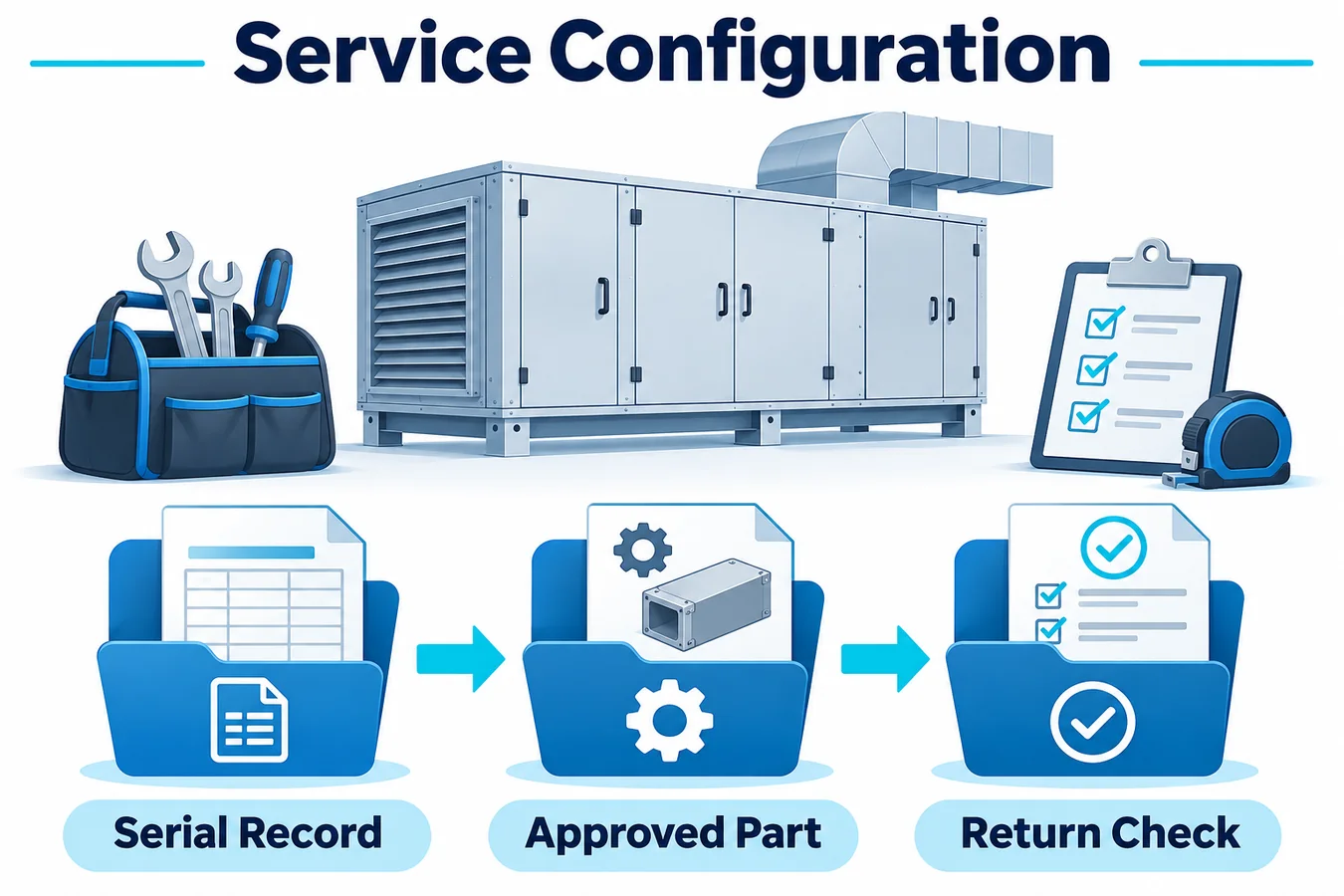
Give service a lookup based on the equipment identity. It should resolve the applicable sensing assembly, bracket and harness where relevant, controller compatibility and prescribed verification. A common series name can remain useful for catalog navigation while the actual replacement is selected using the controlled applicability record.
If the replacement includes a controller update or a new configuration package, show the relationship in the service instruction and kit contents. Record whether the replacement supports earlier units directly or requires coordinated changes. Ensure that the service record captures what was actually installed and the results of the applicable checks, with an exception route for a unit whose original configuration cannot be established.
Periodically test the lookup with an older serial and a current spare order. Ask whether a technician can obtain the correct item without knowing the original supplier’s naming conventions. If two revisions look alike, the identifying information must survive normal handling and remain accessible through the approved service method. Feed returned-part and mismatch findings back into the platform ledger.
Review the economics using the full configuration workload
Compare the proposed commonality strategy using purchasing volume, station changes, qualification effort, inventory segregation, service training and expected change reviews. A common board might reduce hardware inventory while increasing the importance of software readback. Separate configured modules might add stock items while making receiving and replacement decisions easier. Calculate those costs using the actual processes the OEM will maintain.
Include the burden of keeping evidence usable across several years of production. Each additional allowed combination creates a relationship to preserve through revisions. The platform team should understand how many combinations are active, which are limited to service and which have been superseded. A controlled list can reduce avoidable combinations while preserving the product choices the business requires.
At the release review, identify the person responsible for each commonality claim. Mechanical engineering owns the relevant fit and assembly claim, controls owns the interface and software relationship, manufacturing owns the repeatable verification process, and the designated product authority approves the complete release. Assigning those responsibilities helps resolve a future supplier change without reconstructing the original design meeting.
Close the launch decision with a release snapshot
At the launch review, export a snapshot of the approved combinations and the evidence index used to approve them. Identify the order codes enabled for production, the supplier revisions accepted at receiving and the software packages available at each relevant station. Record open development items separately with their effect on launch scope. The snapshot gives future teams a stable reference when the live ledger changes.
Run a small order-to-service exercise using actual release candidates. Start with an order code, produce its BOM and programming instruction, resolve the sensing assembly from the receiving record, and retrieve the installed software identity. Then use the resulting serial to request a service replacement. Compare the answers with the compatibility ledger. Any disagreement identifies a process interface that needs correction before volume manufacture.
Include a deliberately mismatched example in the exercise. A board from another variant or a superseded assembly can reveal whether the system merely stores identifiers or actually checks the allowed relationship. Keep the challenge controlled and record its expected disposition. The result helps the release team see which errors are detected automatically and which still depend on a documented human review.
Assign an owner for maintaining the ledger after launch. Supplier engineering, production rework and service may discover changes at different times. A named product authority can bring those proposals into the same configuration review, preserve effective serial ranges and ensure that approved changes reach the purchasing, software and service systems together.
Evaluate the ZRT512E candidate against the variant record
Winsen publishes the ZRT512E as an R454B and R32 series. Use that family as a candidate for an OEM review and request the exact supplied assembly, suffix, supported refrigerant configuration, interface document, firmware identification and change process. Determine how those records map to the equipment variants under consideration. The evaluation should establish the specific combinations that the OEM can release and support. Winsen ZRT512E manufacturer profile

Use the local product listing to begin the commercial discussion, then obtain controlled documents for the exact proposed samples and production configuration. Include intended markets, equipment variants and the required traceability method in that request. Lista produktów ZRT512E
Często zadawane pytania
Can one sensor family support a shared R32 and R454B platform?
A supplier family can be considered for both variants when its documentation supports the proposed configurations. The OEM still needs a defined combination record and evidence for each equipment variant. Confirm the exact assembly and identity mechanism before assuming that a family description establishes interchangeability.
Should the controller use one firmware executable?
That is an architecture decision. A common executable can work with separately controlled configuration data when the equipment program verifies the relationship. Separate executables can simplify some release boundaries while increasing software maintenance. Evaluate either approach against wrong-variant detection, updates, diagnostics and field replacement.
Can the R32 installed test report cover the R454B release?
Review each claim in the report against the proposed variant. Some unchanged interface or mechanical evidence may remain applicable. Refrigerant-specific behavior and installed-system claims need a documented applicability assessment and the required evaluation. Preserve reviewer dispositions alongside the configuration record.
What should production retain for every serial?
Retain the configuration identifiers and check results needed to establish which approved combination was built, within the OEM record policy. Include actual readbacks or traceable scans where available and the history of rework that changed the assembly or software.
What is the most useful first platform deliverable?
A small compatibility ledger covering real proposed order codes makes assumptions visible. Pair it with a specimen configuration record and an evidence map. Those three records let the team assign the remaining work to supplier documentation, software integration, installed qualification or manufacturing verification.
Request an OEM platform configuration review
Provide the planned R32 and R454B equipment variants, order-code structure, controller and software architecture, proposed sensing assembly and service strategy. Include the desired commonality goals and the evidence already available for the baseline product. Ask for exact candidate documentation and a review of the compatibility ledger, production identity checks and replacement applicability before freezing the platform release. Contact the OEM integration team
